
Why we built this lab in-house
Commercial-vehicle electronics live in conditions that are punishingly different from passenger cars: 50 °C+ desert exposure, 95% RH tropical humidity, salt-spray on bus chassis, sustained vibration on excavator booms, dust ingress in agricultural duty cycles. Validating against those conditions can't be a single-pass-and-ship event.
Sending samples out to external labs adds two to three weeks per cycle, and an unexpected failure pushes the next sample run into another queue. Running the environmental laboratory and EMC pre-compliance equipment in-house means we can iterate on a design — connector seal, gasket compound, board coating — and re-screen the same week. Formal EMC compliance certification, where the programme requires a stamped certificate, is run at a third-party accredited EMC laboratory; the in-house pre-compliance work is what makes those external runs predictable rather than a coin-flip.
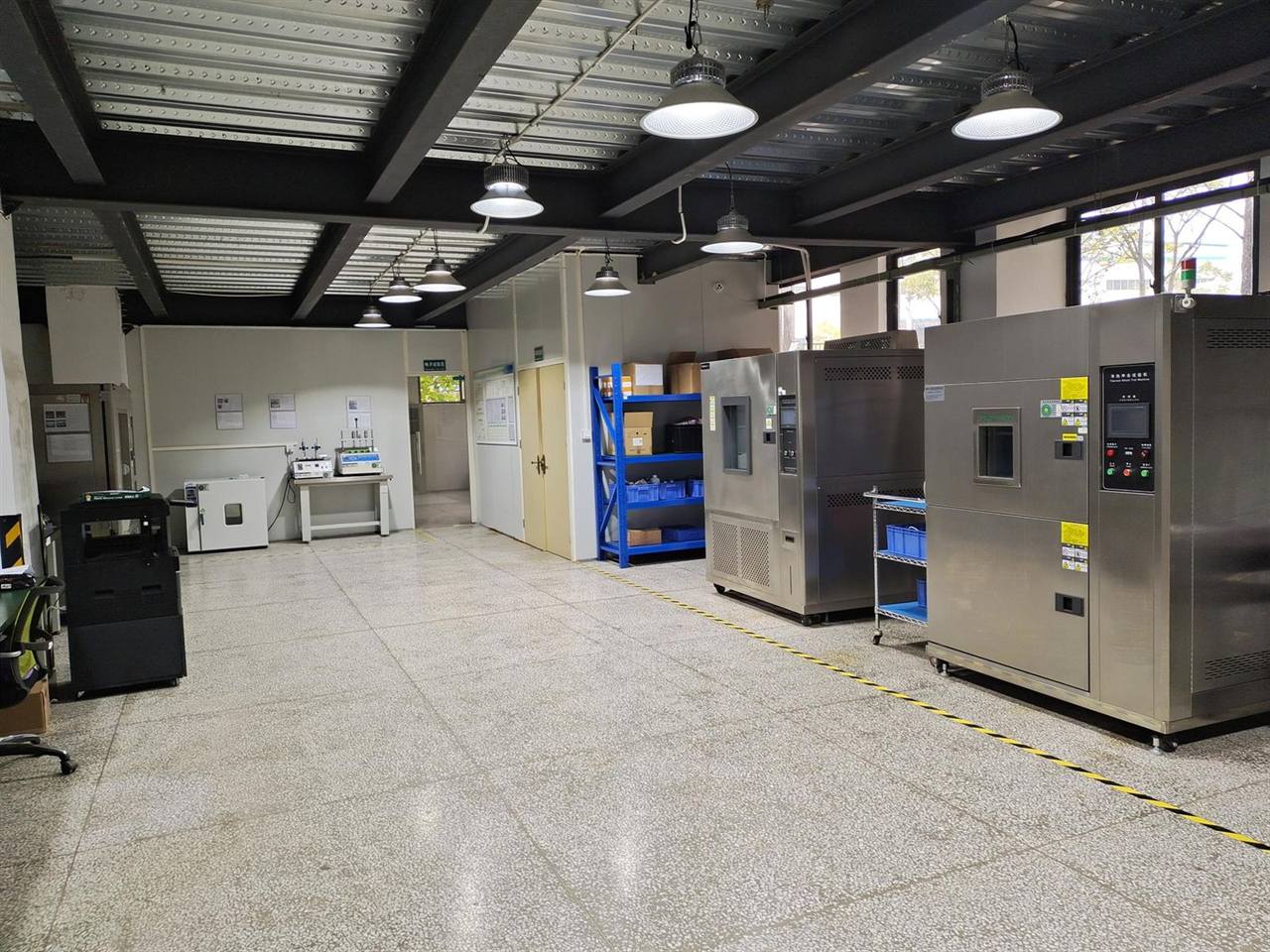
What the lab covers
Climate & environment
| Test | Standard / condition | Typical application |
|---|---|---|
| Temperature cycling | −40 to +85 °C working range (tighter per program) | Working-range validation |
| Constant humidity | 85 °C / 85% RH, sustained | Moisture-driven failure modes |
| Thermal shock | Hot / cold plate step-change | Solder-joint & PCB stress |
| Salt-spray | ASTM B117 chamber | Connector & enclosure corrosion — bus / coastal routes |
| Dust ingress | IP5X / IP6X dust chamber | Runs with the IP65 / IP67 program |
Mechanical
| Test | Standard / condition | Typical application |
|---|---|---|
| Vibration | Multi-axis table; excavator & heavy-truck spectra | Harness-mount & chassis-mount validation |
| Mechanical shock | Drop & bump | Handling & field-service scenarios |
Electrical & EMC
| Test | Standard / condition | Typical application |
|---|---|---|
| ESD | Per automotive standards | Electrostatic-discharge robustness |
| Surge / load dump | ISO 7637-2 transients on the supply rail | Transient immunity |
| Conducted & radiated immunity | Pre-compliance screening | Before customer / third-party formal testing |
| Functional electrical test | End-of-line stations | Every assembly line |
How it ties into the IATF process
The lab is run as part of our IATF 16949 manufacturing system. Test plans are written into the project APQP, executed against a documented procedure, recorded with traceable equipment IDs, and the resulting reports feed the validation record and the PPAP package where a programme requires it.
Market compliance paths differ: UNECE type approval / e-Mark where applicable, SASO/SABER for Saudi Arabia, FCC equipment authorisation (Certification or SDoC by device type), and any applicable DOT/FMVSS self-certification for the United States. Those paths are separate from IATF 16949; the in-house lab does the pre-compliance work that makes third-party or formal runs more predictable. For how buyers should separate system certification from market compliance, see the OEM sourcing guide.
Where it shows up in the product
Models across the four Youlai product families are validated through this lab:
- Power distribution boxes (NBX‑957, NBX‑971, NBX‑961, etc.) — see Power Distribution.
- BCM, VCU, PMU, T-BOX modules — see Smart Control Modules.
- Switch panels, TPMS, sensors — see Switches & Sensors.
- HUD, CMS mirrors, clusters — see Displays & HUD.
Asking for the test reports
Test reports for the standard NBX, EBX, EDK and PBX series are shared as part of the PPAP package once a program is engaged. For early evaluation, please reach out via WhatsApp or email — typical reply within one business day.