Overview — Vehicle-to-Load on a new-energy commercial vehicle
A modern electric heavy truck or electric work vehicle carries a 400-1100 V traction pack sized for hundreds of kilometres of range. On a typical work day that pack stores 200-400 kWh of energy that sits idle whenever the vehicle is parked — at a construction site, at an emergency-response location, at a remote mining or agricultural operation. Vehicle-to-Load (VTL) is the use case that taps a fraction of that stored energy and converts it into a grid-compatible AC supply that the operator can plug standard tools, lights, refrigeration units and small machinery into. On a diesel truck the equivalent function needs a separate towed generator set; on an electric truck with a VTL inverter installed, the whole vehicle becomes the generator set.
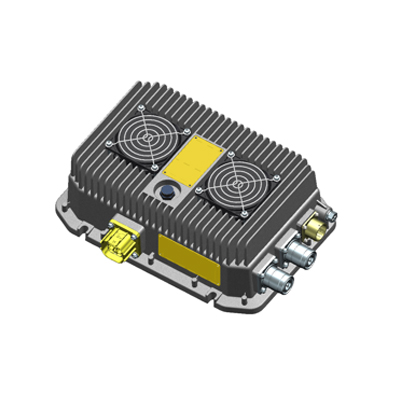
The EBX-2514 is the 30 kW HV-DCAC inverter that makes the VTL use case real. The input side connects to the same high-voltage DC bus that the traction inverter and the HV-DCDC controllers (EBX-2314, EBX-2512) draw from — 400-1100 VDC working range, rated at 600 V or 900 V per the host vehicle programme. The output side is the standard 220 VAC / 50 Hz three-wire (L / N / PE) interface that every Chinese-market handheld power tool, work-light, refrigeration compressor and small machinery item already speaks. At 30 kW continuous, the EBX-2514 can supply a small construction site with multiple power-tools and a lighting bank running simultaneously, an emergency-relief mobile-clinic with full lighting + medical-equipment loading, or a refrigerated-truck cold-chain load that needs to stay on overnight without the engine running.
Engineering details
Quad-fan forced-air cooling
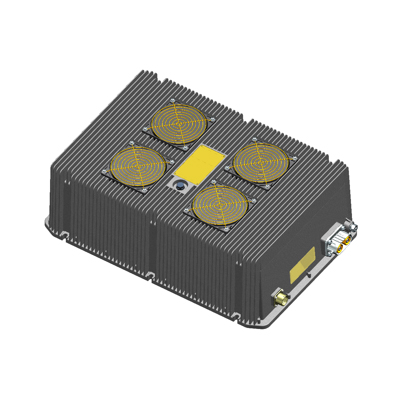
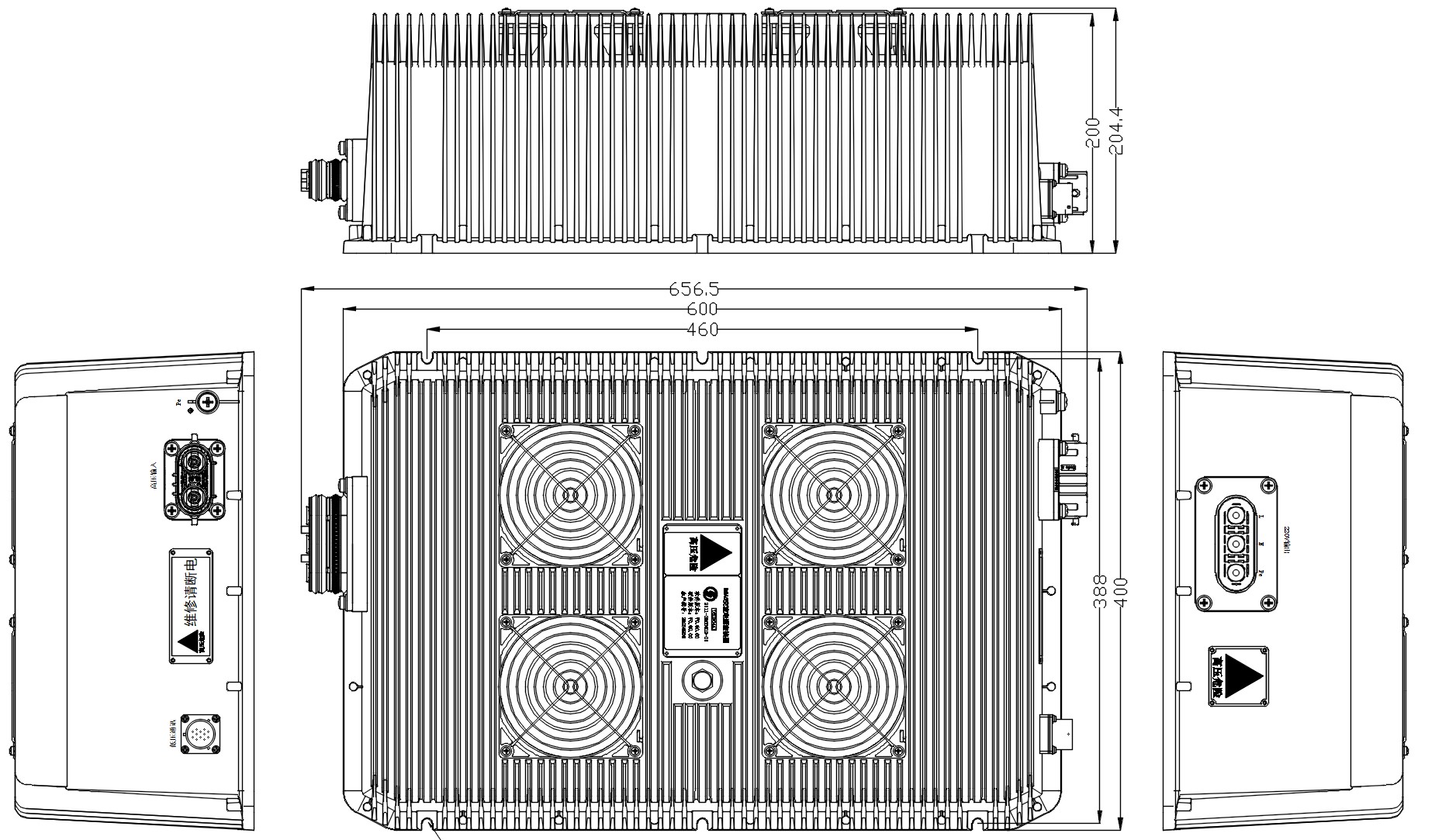
30 kW of continuous power conversion at typical ≥ 90 % efficiency still produces ~3 kW of thermal load that the housing has to shed — five times the thermal load of the 6 kW EBX-2512. The EBX-2514 uses a quad-fan arrangement (four axial fans in a 2×2 grid) on the heat-sink top face, spread across the much larger 600 × 388 mm body. The four-fan parallel arrangement gives airflow redundancy (one fan can fail and the unit still operates at de-rated power, two fans can fail and the unit still survives the typical worst-case duty cycle) and keeps the per-fan working point well inside the high-efficiency / low-noise envelope. The source design notes mark the inverter as a "high heat-source device" that requires guaranteed cooling airflow and explicitly cautions against placing heat-sensitive parts close to the inverter envelope.
Three-wire AC output (L / N / PE)
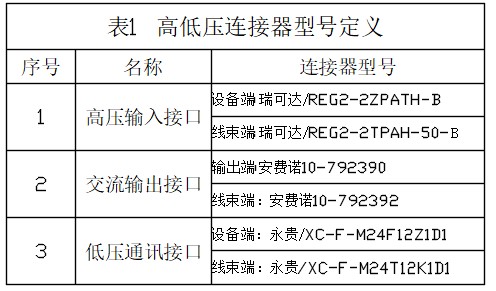
The output side is a three-wire grid-compatible interface — L (live), N (neutral), PE (protective earth) — on a single industrial-grade Amphenol 10-792390 board-side connector mating with the Amphenol 10-792392 harness-side. The PE conductor is bonded to the inverter chassis through the housing-grounding path; on the output side the operator can simply plug a standard 220 VAC power-tool / lighting rig / work-equipment item with the standard Chinese-market 3-pin plug into the user-end socket that the harness routes to. The 30 kW continuous rating spans the typical small-construction-site / mobile-clinic / cold-chain duty cycle without throttling.
High-voltage safety stack — matched to the EBX-2512
The HV safety stack is identical to the EBX-2512:
- GB 18384-2020 high-voltage warning marking on the housing visible faces — "高压危险" (HV danger) + "维修请断电" / "绝缘调断电" service instruction labels
- SQB 10055 part-traceability marking on every unit
- DC 4480 V / 1 min (or AC 3200 V / 1 min) live-to-chassis withstand voltage with no breakdown and no arcing
- Leakage current ≤ 5 mA under the withstand test
- Insulation resistance ≥ 20 MΩ at 90 % relative humidity
Shared low-voltage signal connector for system integration
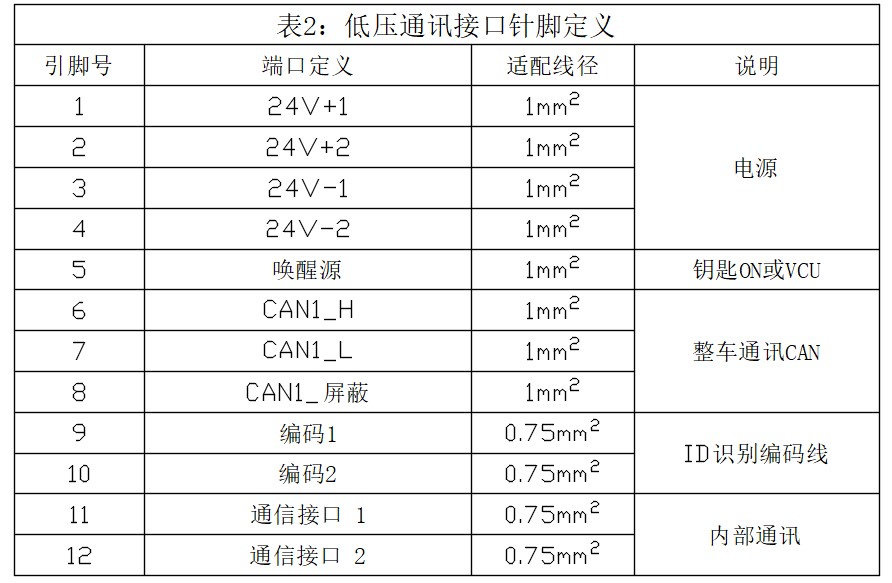
The 12-pin Yonggui XC-F-M24 low-voltage signal connector is the same family used on the EBX-2512 and (on the equivalent integration role) on the controller side of the EBX-2314. The shared connector + shared 12-pin pin-out means the OEM-side wiring harness on the VCU integration uses the same connector type, the same wake-up handshake and the same CAN ID conventions across the whole new-energy power-conversion family — one connector family to qualify, one wiring loom design pattern to validate, one CAN signal-ID convention to maintain. Pins 1-4 carry the 24V supply (dual-pin redundancy), pin 5 the key-ON / VCU wake-up, pins 6-7-8 the vehicle CAN bus (CAN1_H / CAN1_L / shield), pins 9-10 the 2-bit board ID-code, pins 11-12 the internal-communication links.
Mechanical drawings — top, side and front views
High & low-voltage connector reference (table 1)
Low-voltage signal connector pin-out (table 2 — common to EBX-2512 and EBX-2514)
Comparison with the related Youlai HV power modules
| Model | Output type | Output power | Cooling | Footprint | Use case |
|---|---|---|---|---|---|
| EBX-2314 | DC (18-32 V) | 36 kW (24V auxiliary) | Programme-spec | 200 × 500 × 200 | Heavy-duty main HV→24V DCDC |
| EBX-2512 | DC (16-32 V) | 6 kW (24V auxiliary) | Dual-fan IP68 | 344 × 244 × 114 | Mid-duty / secondary HV→24V DCDC |
| EBX-2514 | AC (220 V / 50 Hz / L+N+PE) | 30 kW (VTL) | Quad-fan IP68 | 656 × 400 × 204 | Vehicle-to-Load (mobile power source) |
The EBX-2514 is the right choice for any new-energy commercial vehicle programme that wants to monetise the Vehicle-to-Load capability — mobile-power-station role on a construction-site work vehicle, emergency-relief role on a municipal-fleet vehicle, off-grid power role on a remote-operations vehicle. For the conventional HV→24V DCDC role to feed the vehicle's own auxiliary bus, look at the heavy-duty EBX-2314 (36 kW main DCDC) or the mid-duty EBX-2512 (6 kW integrated DCDC).
Manufacturing & testing
Built under IATF 16949 with APQP project planning and a PPAP package available for OEM programmes. Every unit is end-of-line functional-tested before packaging — the HV input voltage range across the 400-1100 VDC envelope (at the rated 600 V and 900 V working points), the 220 VAC / 50 Hz output regulation under the full 30 kW continuous load, the output waveform quality and the harmonic distortion check, the DC 4480 V / 1 min (or AC 3200 V / 1 min) live-to-chassis withstand voltage check, the leakage-current measurement (≤ 5 mA), the insulation resistance check at 90 % RH (≥ 20 MΩ), the quad-fan operation (each fan independently driven and monitored), the CAN bus health on the 12-pin signal connector path, the 2-bit board ID-code read-back, the key-ON / VCU wake-up handshake and the IP68 main-housing ingress baseline are all checked.
How to ask
The EBX-2514 belongs to the Smart Control Modules family. To request the harness drawing, the HV-side rated voltage selection (600 V vs 900 V) per your traction-pack architecture, the AC output socket configuration option (industrial Chinese 3-pin / European Schuko / Asian fleet-standard variations), the CAN signal-ID assignment for VTL enable / disable / output-power-limit / fault reporting, or a PPAP package, please use the contact page with your target vehicle programme, traction-pack nominal voltage and working range, expected annual volume and key technical requirements (VTL peak load, expected daily VTL hours, mounting position, EMC profile, IP grade). Drawings welcome.