Overview
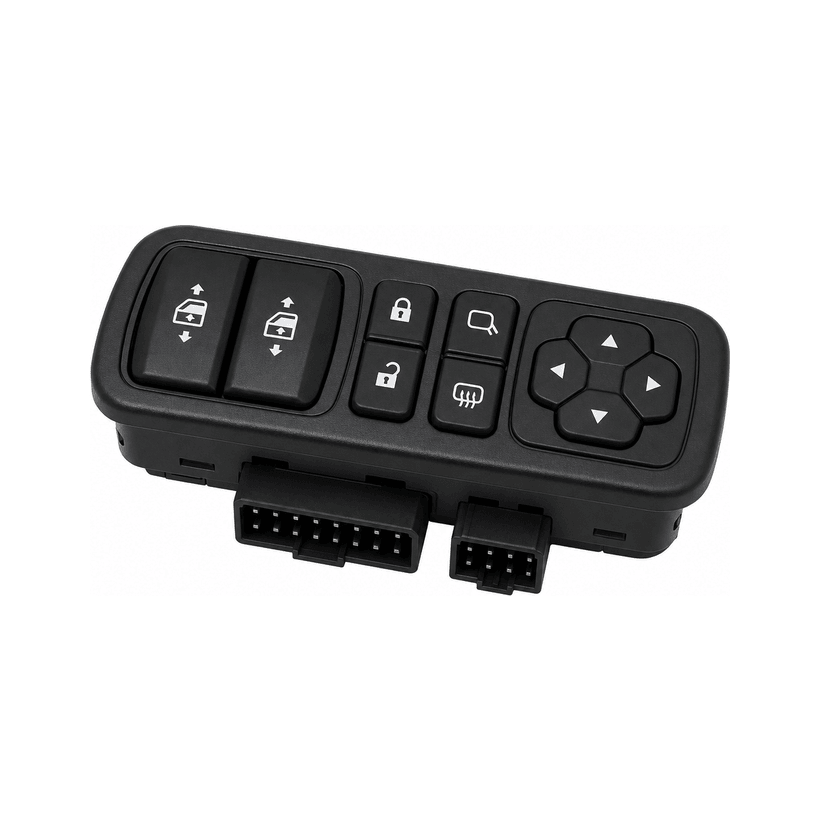
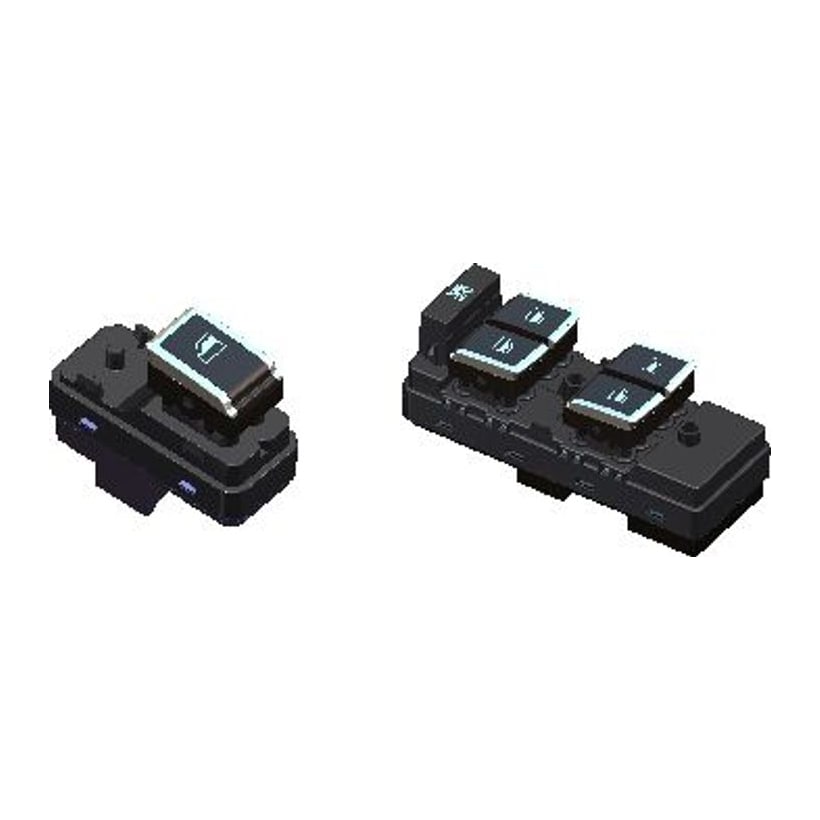
The TDK-2202/3 is a 12 V power-window and central-lock switch for passenger cars and new-energy vehicles. It comes in two models: a driver master switch that carries several window rockers and a central-lock button, and a single-window switch for the other doors. Which model goes on which door depends on the vehicle's window layout, so the two are specified together against your door plan rather than as a fixed kit.
Each switch drives its window motor directly — the rocker makes and breaks the motor's up/down circuit at a 25 A carry rating — and carries a LIN line that ties the door into the vehicle's door-and-lock network. In one part it is both a load-carrying motor switch and a networked door control.
Direct motor drive, with a LIN line for the doors
Press up and the switch closes the motor's raise circuit; press down and it closes the lower circuit. There is no separate window-lift module in the path for that basic movement — the current runs through the switch, rated 25 A carry, with contacts held to a voltage drop of ≤ 300 mV so little is lost on the way to the motor. The relay limits for a held window command and for overcurrent are in the table above. The overcurrent trip is not force-based anti-pinch (see the EBX-2206 anti-pinch module).
Alongside the drive contacts, a LIN line handles the slower, coordinated door jobs. On the master switch the central lock and unlock commands appear as their own signal pins, with a lock-indicator output back to the driver, while LIN links the door into the rest of the vehicle. The split is deliberate: the high-current window movement stays local and direct, while the door-to-door signalling rides a single data wire rather than a bundle of discrete lines.
The two models: master and single-window switch
Both switches share the electrical concept but differ in what they carry. The driver master switch uses a 16-way connector and hosts the window rockers plus the central-lock button, the lock-indicator output and the LIN line to the rest of the vehicle. The single-window switch uses an 8-way connector, drives one window up and down, and its published pinout carries rear-window select lines. Which model number ships as the master and which as the single, and exactly how those select lines are used, is confirmed per programme against your door layout. The 8-way DJ7081-2.3-21 on the single-window switch is the same housing family used by the TDK-901 hazard switch, which is worth knowing if you are trying to hold down the number of connector part numbers across a cab harness.
Connector pinouts
Each switch has a published connector definition, which lets a harness team plan the door before samples arrive. The layouts below are the published pinouts.
| Pin | Function |
|---|---|
| 2 | LIN communication |
| 4 | Central unlock signal |
| 6 | Central lock signal |
| 11 | Ground |
| 12 | +12 V supply |
| 13 | Lock-indicator output |
| 14 | Window motor — up |
| 15 | Window motor — down |
| Pin | Function |
|---|---|
| 1 | Rear-window select (R) |
| 2 | Ground |
| 3 | Window motor — up |
| 4 | Rear-window select (L) |
| 5 | LIN communication |
| 6 | Not connected |
| 7 | Window motor — down |
| 8 | +12 V supply |
Pins not listed above are left open in the base build; they are where programme-specific options are added once the door plan is fixed. If your build needs functions beyond window and central lock, send the door specification and we will confirm which lines are available on each connector.
Feel, marking and durability
A door switch is touched every trip, so the tactile side is specified alongside the electrical. Button force is held to 5 ± 1.5 N for a consistent press, and the mechanism is qualified to 30,000 operating cycles. The switch works across a −40 to +80 °C cabin range. Two separate insulation figures are specified: an insulation resistance of ≥ 5 MΩ, and a 550 V, 50 Hz dielectric-withstand test in which the insulators — between housing and conductive terminals — show no breakdown. Its graphical symbols follow ISO 2575 and are laser-etched rather than printed, so they do not wear off the keycap.
Passenger 12 V here, commercial 24 V there
This set is drawn for a 12 V vehicle — a 9 to 16 V working range, ISO 2575 symbols and compliance with the QC/T 198-1995 automotive-switch specification — which places it on passenger cars and new-energy vehicles rather than an 18–32 V cab. The distinction matters when you are sourcing, because the same LIN-based door-and-window idea appears in both worlds with different voltages and connectors:
- TDK-2202/3 — 12 V passenger & new-energy. Direct window-motor drive plus discrete central-lock signals and a LIN line, on the door layout of a car or NEV.
- EDK‑908 — 18–32 V door and window control. The counterpart on an 18–32 V system, with its own outputs. The EDK-908B on the same page is a separate 9–32 V switch.
- EDK‑914 — 24 V window-focused LIN switch. Where a cab door only needs its windows and central lock rather than the full mirror set, the EDK-914 is the leaner 18–32 V option at IP53, in single- and dual-button variants.
For the wider picture — where window and door logic belongs on a discrete switch, a LIN module or the body controller — see the power-window & door-control module article, or the switches & sensors technical guide. To compare the 12 V TDK-2202/2203 against the 24 V EDK-908 and EDK-914 on the switch side, see the power-window & door switch panels buyer guide; for the interface-level choice — LIN, hard-wire or CAN — see CAN vs LIN vs hard-wired switches.
Manufacturing & testing
Built under IATF 16949 with APQP project planning and a PPAP package available for OEM programmes. End-of-line testing follows the programme's control plan — typically contact continuity, voltage drop and actuation force — while endurance, the relay-trip points and temperature soak are validated on a sample basis in our in-house lab when a programme calls for fresh qualification.
Common questions from buyers
Does it drive the window motor directly, and what happens above 12 ± 0.7 A? It drives the window motor directly — the rocker makes and breaks the motor's up/down circuit at a 25 A carry rating, so no separate window-lift module is needed for basic up/down. Above 12 ± 0.7 A the switch opens its relay within 3 s. Releasing the switch restores operation.
Is the trip above 12 ± 0.7 A the same as anti-pinch? No. The relay opening above 12 ± 0.7 A is not force- or position-based anti-pinch. Anti-pinch (obstruction detection with auto-reverse and self-learning of the window travel) is a module-level feature — on our range that is the EBX-2206 self-learning anti-pinch window module. If your programme requires anti-pinch, tell us and we will scope it at the module level rather than the switch.
What connectors do the two switches use? The driver master switch uses a 16-way TE/AMP 174147-2 connector carrying a LIN line, window-motor up/down, central lock and unlock signals, a lock-indicator output, +12 V and ground; the single-window switch uses an 8-way DJ7081-2.3-21 connector carrying a LIN line, window-motor up/down, rear-window select, +12 V and ground. The pin numbers are published in the tables above. Pins not listed are left open.
Is it sealed, and what IP rating does it carry? It is drawn for the trimmed, dry door environment inside a cabin rather than a wash-down or exterior mounting. If your installation needs a defined ingress rating, tell us the mounting and we will confirm what sealing level can be supported for the programme.
Is this a 12 V car part, or can it be used on a 24 V commercial vehicle? As drawn it is a 12 V design (9–16 V working range) for passenger cars and new-energy vehicles. For a 24 V cab, the LIN door-switch family covers it instead — the EDK‑908 switch panel where the door also needs mirror control, or the leaner EDK‑914 where it only needs its windows and central lock. Tell us the system voltage and the window and lock layout and we will point you to the right part.
How to ask
The TDK-2202/3 belongs to the Switches & Sensors family. Tell us the target vehicle programme, the door and window layout (how many windows the master drives, whether the single switch commands a rear window), and the window-motor current — and we will confirm the relay trip against your motor, and the symbol set. Use the contact page; drawings welcome.