Overview
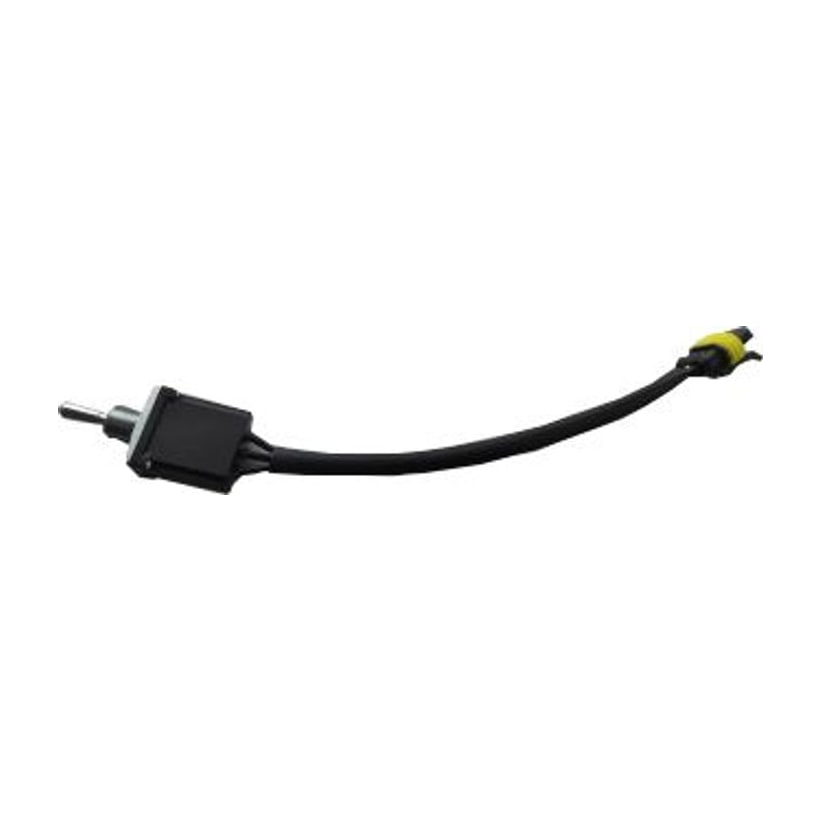
The JDK-2201 is a sealed toggle switch for the jobs that are better kept off the bus — an auxiliary-lamp feed, a two-mode or raise/lower selector, a pump or fan enable. As drawn it is a three-position, self-latching switch: the bat handle moves to one of two positions and stays there, with a center-off in between, so the state is clear by feel without looking down. There is no body-control module and no CAN message in the path — the contacts make and break the circuit themselves.
It is also built to sit where a dashboard panel cannot. The body is sealed to IP67 and rated to 95% humidity across a −40 to +85 °C range, and it ships as an assembly with an integrated lead that terminates in a sealed connector, so it can go on an exposed panel rather than only the dry cab. It is a mechanical part with a real current rating, not a low-current logic input.
Switching configuration & terminals
The base JDK-2201 is a three-position (ON-OFF-ON), self-latching toggle wired through a three-terminal TE 282105-1 connector (mating housing 282087-1). Terminal 2 is the common; terminals 1 and 3 are two normally-open contacts. The lever connects the common to contact 1, to contact 3, or — at center — to neither, which is what lets one switch pick between two circuits with a safe off in the middle: a two-speed fan, a raise/lower valve, an A/B mode select. Which side carries the supply and which the load, and the exact pinout, are confirmed against your harness at RFQ.
Swipe sideways to read the full diagram.
The same body is offered in other switching schemes per programme — two-position ON-OFF or ON-ON, and momentary self-return instead of self-latching — so the number of positions, the contact scheme and whether the lever latches or springs back are all fixed when the switch is quoted.
Two current ratings, one switch
The JDK-2201 is rated 15 A on a 24 V system and 25 A on a 12 V system — one switch qualified on both common commercial-vehicle voltages, the two figures describing how the contacts break the load at each. Read across to the rating that matches your electrical system and keep the switched load within it. Within that envelope the toggle carries the circuit directly, with no interposing relay, which is the whole reason a mechanical switch with a real current rating is specified where a signal-level input would need a relay and extra wiring to do the same job. Inrush-heavy or inductive loads — motors, pumps, lamps at switch-on — are checked against the contact rating at quotation rather than assumed from the steady-state current. For a load above the rating — a winch motor, a high-current heater, a battery main feed — the toggle instead drives the control side of a relay or contactor, and the contact rating is matched to the real circuit current.
Sealing, life & environment
The IP67 rating means the switch is dust-tight and withstands temporary immersion (1 m for 30 minutes), and the sealed lead carries that protection through the wiring exit — the reason it suits exposed panels rather than only a dry dashboard. The self-latching detents give a defined, repeatable feel, the operating force is held to ≤ 24 N, and the mechanism is qualified to 50,000 operating cycles. For chemically aggressive engine-bay exposure or continuous high-pressure wash-down, confirm the mounting location against the sealing spec at RFQ rather than assuming IP67 alone covers it.
Switch-performance testing is validated against a major China automotive OEM's switch-qualification standard, and the materials roster meets the ELV end-of-life-vehicle directive (2000/53/EC), a flow-down requirement on most first-tier commercial-vehicle bills of materials. Cosmetic acceptance covers a clean surface free of scratches, scuffs and cracks, and the action is checked to move freely without sticking.
Toggle, CAN panel or emergency-stop?
Three switches that look related are not interchangeable:
- JDK-2201 — sealed mechanical toggle. One rugged, bus-independent selector that carries real load (15 A / 24 V, 25 A / 12 V) and is sealed to IP67 for exposed mounting. Use it where bus-independent direct switching is the right call.
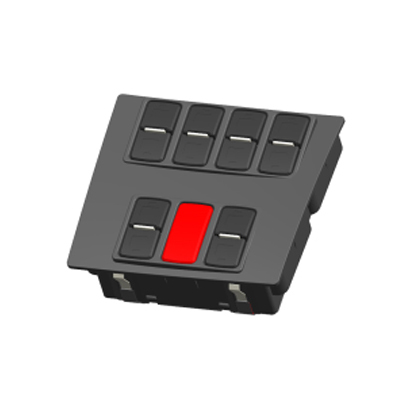
- EDK‑907 — CAN switch panel. A multi-key dashboard panel whose keys are low-current logic inputs reported to a body-control module over one CAN pair, sealed to IP53 for the cab. Use it when many functions share a console and harness reduction and bus diagnostics matter.
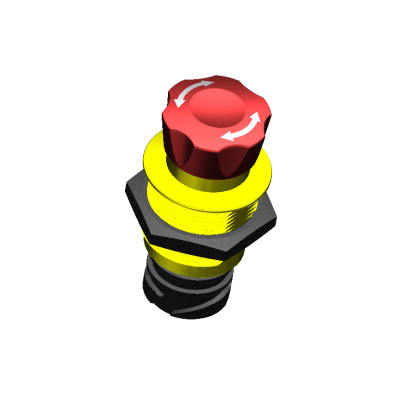
- JDK‑2425 — emergency-stop / cut-off. A latching mushroom-head button for a safety interrupt: struck to actuate, rotate-to-release, sealed to IP67. Use it when the function is an emergency stop, not a routine selection.
For the architecture behind bussed versus hard-wired switching — who owns the message matrix, and when a CAN panel earns its place over discrete switches — see the CAN bus switch panel buyer guide, or the CAN vs LIN vs hard-wired switches comparison for choosing the interface itself.
Manufacturing & testing
Built under IATF 16949 with APQP project planning and a PPAP package available for OEM programmes. End-of-line testing follows the programme's control plan — typically contact continuity and resistance, actuation and a seal check — and endurance, humidity and the switch-performance schedule are validated on a sample basis in our in-house lab when a programme requires fresh qualification.
Common questions from buyers
Is the JDK-2201 a two-position or three-position toggle? As drawn it is a three-position, self-latching toggle with an ON-OFF-ON scheme: the lever selects one of two circuits and holds, with a positive center-off in between. Two-position (ON-OFF or ON-ON) and momentary self-return versions are available in the same body per programme, so state the number of positions and whether you need self-latching or spring-return when you enquire.
What do the three terminals connect to? The switch is wired through a three-terminal TE 282105-1 connector (mating housing 282087-1). Terminal 2 is the common; terminals 1 and 3 are two normally-open contacts, so the lever connects the common to contact 1, to contact 3, or to neither at center-off. Which side carries the supply and which the load, and the full pinout and lead length, are confirmed against your harness at RFQ.
Why two current ratings — 15 A at 24 V and 25 A at 12 V? It is one switch qualified on both common commercial-vehicle system voltages; the contacts are rated 15 A on a 24 V system and 25 A on a 12 V system, because a DC arc is harder to break at the higher voltage — the mechanism is set out in 12 V vs 24 V commercial vehicle electrical systems. Specify the rating for your system voltage and keep the switched load within it. For a load above the rating, switch the control side of a relay or contactor rather than carrying it through the toggle.
Can it switch a motor or lamp load directly? Within its rating, yes — the contacts make and break the circuit directly, with no relay or bus in between, which is what makes a rugged mechanical toggle useful for an auxiliary lamp, pump or fan. For inductive or inrush-heavy loads near the rating, or anything above it, use the toggle to drive a relay or contactor and size the contact rating to the real circuit current.
How to ask
The JDK-2201 belongs to the Switches & Sensors family. Tell us the target vehicle or machine programme, the system voltage (12 V or 24 V) and switched-load current, the switching you need (number of positions, self-latching or momentary, and the contact scheme), the mounting location and expected annual volume — and we will confirm the terminal pinout and lead length against your harness. Use the contact page; drawings welcome.