Overview
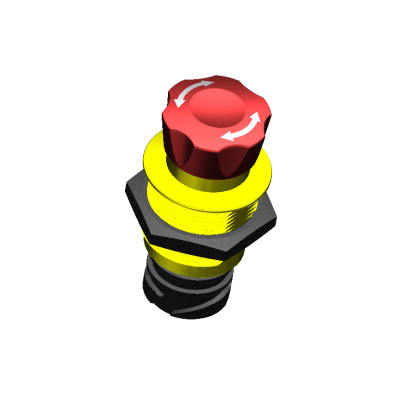
The JDK-2425 is the cab-side or chassis-side push-button cut-off switch that almost every commercial-vehicle programme needs at least one of — main power kill, hydraulic-pump cut-off, fuel-pump interrupt, bus-passenger emergency-call lockout, or the emergency-stop on a construction-machine cab. The mushroom-head geometry is the standard for emergency-stop functions: a single hand-strike actuates it (no fine-motor accuracy required, even under stress), it latches in the actuated state, and a quarter-turn release returns it to the neutral state without leaving the operator wondering whether the cut-off has really cleared.
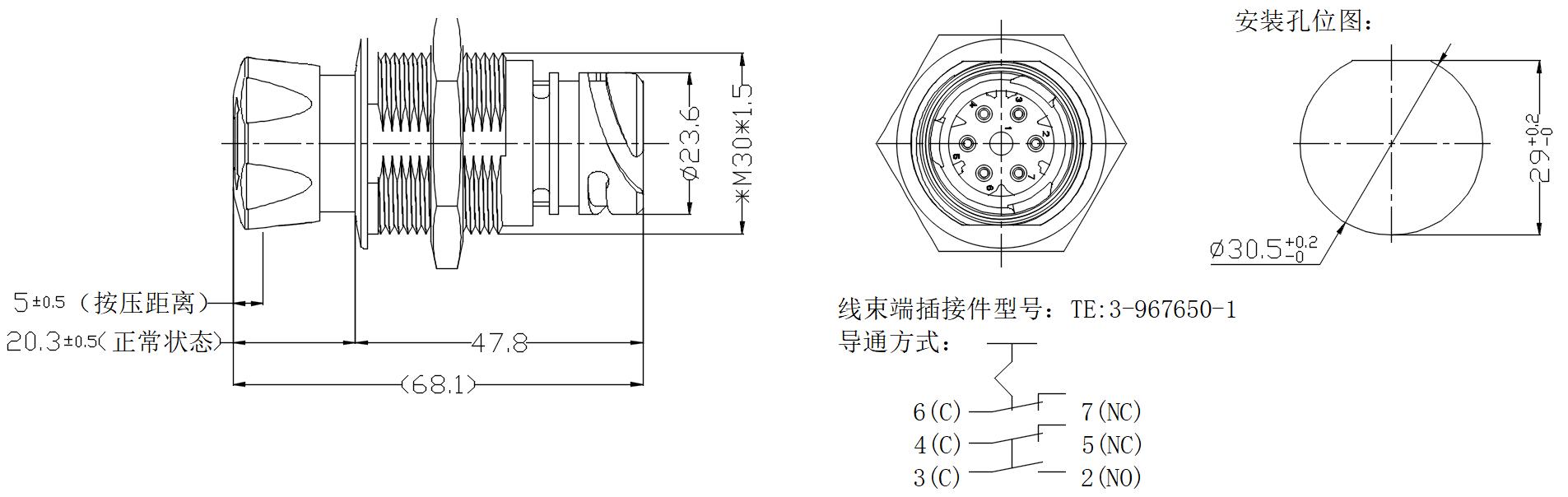
The body is a single-piece moulded enclosure with a yellow dust ring around the red button head — visible from the cab-door angle even with the panel half-obscured. The threaded base mounts through a standard Ø30.5 mm panel hole, with an internal anti-rotation tab on a Ø29 mm reference, then secured with the panel-mount nut to the specified 3 N·m. Three contact pairs let the same switch interrupt up to three independent circuits — typical for a programme that wants the main power line, the ECU wake-up line and a status-feedback to the body-control module to all break together.
Why a 10 A rated contact matters
The JDK-2425 is rated 10 mA – 10 A across the contact pair, a wide range that lets the same SKU cover two very different jobs without changing part. On the low end (10–500 mA), the switch interrupts a low-current control signal — typically an ECU enable line or a body-control module input. On the high end (1–10 A), it directly breaks an auxiliary or accessory circuit that falls within that rating, with no interposing relay needed for those loads. For higher-current paths — a battery main feed or a hydraulic-pump circuit well above 10 A — the cut-off breaks the control side of a contactor or battery isolator rather than carrying the load itself; the contact rating is matched to the actual circuit current at quotation. A cut-off rated only at signal level (sub-amp) cannot break even a modest auxiliary load directly, so the 10 A contact is what gives the harness designer that headroom.
Durability & corrosion protection
The 100,000-cycle operation life is the headline number — at a heavy-truck duty cycle (the emergency-stop should obviously not be used in normal operation, but is still routinely tested during maintenance), that translates to decades of safe service life. Metal components and the internal PCBA carry a corrosion-protection coating qualified to 360 h of GB/T 10125-2012 neutral salt-spray, with the post-test acceptance being no red rust and no blistering. This is in line with the corrosion duty cycle of a chassis-mounted switch on a coastal-route heavy truck or a marine-export construction machine.
Mechanical tolerances on the moulded parts follow GB/T 14486-2008 MT5 where individual dimensions are not separately specified — a tighter-than-default tolerance class that catches the moulding-cavity drift that would otherwise show up as inconsistent button feel across a production run.
Hazardous substances & export compliance
The materials roster is fully compliant with the REACH and ELV hazardous-substance directives — directly relevant for European-market programmes and for first-tier OEM bills of materials where component-level compliance is a flow-down requirement to the harness builder. A declaration of conformity is available on request as part of the PPAP package.
Manufacturing & testing
Built under IATF 16949 with APQP project planning and a PPAP package available for OEM programmes. End-of-line testing covers contact resistance per pair, post-actuation latching verification, rotate-to-release torque, and 100% connector insertion force on the harness-side TE 3-967650-1 before packaging. Salt-spray and operation-cycle endurance is verified on a sample basis in our in-house lab when a programme requires fresh validation.
How to ask
The JDK-2425 belongs to the Switches & Sensors family. To request the contact-wiring schedule for your specific cut-off function, the clear-cover accessory part number or a fleet-grade batch quotation, use the contact page. These help if you already have them: target vehicle / machine programme, expected annual volume, and key technical requirements (number of circuits to break, ambient temperature range, mounting location, clear-cover required Y/N). Drawings welcome. For a routine (non-emergency) sealed selector or on/off toggle rather than a latching cut-off, see the JDK-2201 sealed 3-position toggle switch. On a bus, this cab / chassis power-or-signal cut-off is a different control from the saloon emergency-stop trigger — for the latter see the TDK-2419 bus EDSS emergency-stop unit.