Overview
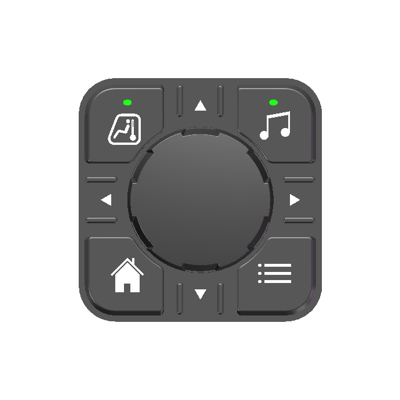
The EDK-2507 brings four discrete buttons, four directional side-pushes and a stepped rotary encoder into a single sealed module that talks to the rest of the vehicle over CAN. Instead of running ten or more switch lines back to a body controller, the OEM harness only needs four wires: 24 V switched supply, ground, CAN H and CAN L.
Mechanically the EDK-2507 is built for the commercial-vehicle dashboard environment — IP66 sealing, 6.8 G vibration and 50 G half-sine shock validation, and a switch-actuator endurance of at least 100,000 cycles per button.
Mechanical & control feel
The control feel is defined down to the gram-force at quotation, so the OEM can match the EDK-2507 against the rest of the dashboard:
- Side-push. 5.5° travel angle, 16.5 N actuation force.
- Vertical press. 0.9 mm travel, 6 N actuation force.
- Rotary encoder. 15° per detent, 450 ± 100 gf·cm torque.
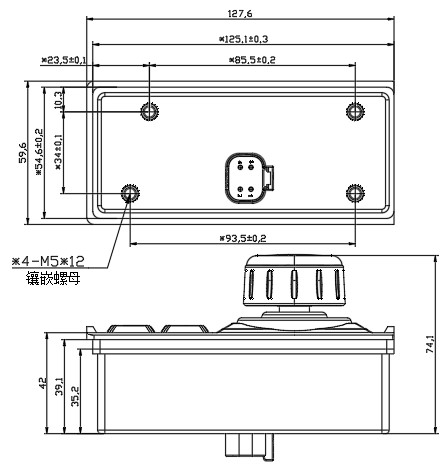
- Mounting. Four M5 threaded inserts on the back face mate with the dashboard cut-out — see the dimensional drawing below.
Electrical interface
The EDK-2507 talks CAN 2.0 over a 4-pin Deutsch DT interface with a harness-side DT06-4S mating connector. The pin map is:
- Pin 1. 24 V switched supply (operating range 9–32 VDC).
- Pin 2. Ground.
- Pin 3. CAN L.
- Pin 4. CAN H.
CAN baudrate and message-ID layout are configured per OEM specification. Typical commercial-vehicle programmes run the EDK-2507 at 250 kbps (J1939-style) or 500 kbps (passenger-platform-style) — confirm at quotation.
Manufacturing & testing
Built under IATF 16949 with APQP project planning and a PPAP package available for OEM programmes. Every unit goes through end-of-line CAN-message verification and a full button / rotary functional test before packaging. Vibration and shock validation per the figures above is run on a sample basis in our in-house lab when the programme requires it.
Choosing the EDK-2507: rotary HMI, rocker grid, or hard-wired switches
The EDK-2507 earns its place when the dashboard job is navigation and selection rather than a wall of always-on toggles. The stepped rotary encoder, four buttons and four directional side-pushes suit scrolling a cluster menu, stepping through drive or climate modes, or picking from a list — a task that a bank of single-function rockers handles badly. Because every press, side-push and detent is published as a CAN message, the whole module reads as one ECU node on four wires, and its IP66 sealing — dust-tight, and tested against powerful water jets rather than immersion or hot pressure-washing — lets it sit in a more exposed cab, door-pillar or off-road dashboard position than a typical IP53 cab panel, where splash, dust and jet-wash exposure are part of normal duty.
Where the cab instead needs many labelled, always-on functions — work lights, beacons, PTO, diff-lock — the EDK-907 CAN rocker panel is the better fit: one legended key per function, plus a 24 V hard-wire backup channel on the one safety-critical key. The EDK-2507 is pure-CAN on a 4-pin Deutsch connector, with no hard-wire backup output, so it suits functions that can ride entirely on the bus. And for a handful of simple, fixed switches that must each work independently of any bus, a discrete hard-wired switch is still the cheaper, simpler answer. For the architecture-level trade-off between CAN panels and hard-wired switching, see the CAN bus switch panel guide, or the CAN vs LIN vs hard-wired switches comparison for the full interface choice.
How to ask
The EDK-2507 belongs to the Switches & Sensors family. To request the dashboard cut-out drawing, custom button artwork or a CAN-message specification, please use the contact page with your target vehicle programme, expected annual volume and key technical requirements (CAN baudrate, button artwork, custom dial labelling, connector preference). Drawings welcome.