Overview
The EDK-907 is a CAN-bus dashboard switch panel that replaces a hand-wired grid of rocker / push-button switches with a single bussed module. On a typical heavy-truck cab, that turns roughly 8–14 individual switch wires plus 12 V / 24 V power and lamp returns into a single CAN pair plus power. The body-control module reads each key state from the bus, runs the relevant function (lighting, mirror heater, fog lamp, differential lock, fan, cab horn, hazard), and the panel renders the resulting status on its backlit function lamps.
Because the bus is the primary communication path, the EDK-907 also carries a hard-wire backup channel — typically assigned to the hazard / warning request — so that the safety-critical key keeps a direct, bus-independent path even in the unlikely event of a complete bus drop-out. This is a standard arrangement for OEM programmes on heavy-truck cabs where a single point of failure on the dashboard would not be acceptable.
Key grid & programme customisation
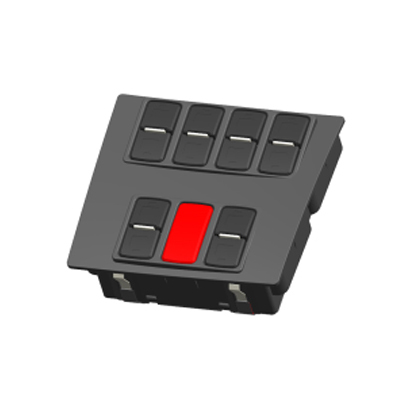
The factory mechanical grid is an eight-position footprint, with the reference build populating seven keys — six rockers in two rows plus a central red hazard / warning key. Both the key legend (the icon screened or moulded into each rocker) and the backlight / function-lamp colour are customizable per programme. The eight-position layout is the standard mechanical footprint, but the active key count and the single-vs-dual-key configuration of each position are also customizable: a programme that only needs four active functions will simply blank the unused positions with a plain rocker.
Cab programmes that have already standardised on a specific icon set or backlight colour scheme will normally specify their own per-key requirements at quotation; programmes coming in fresh can pick from the established Youlai library.
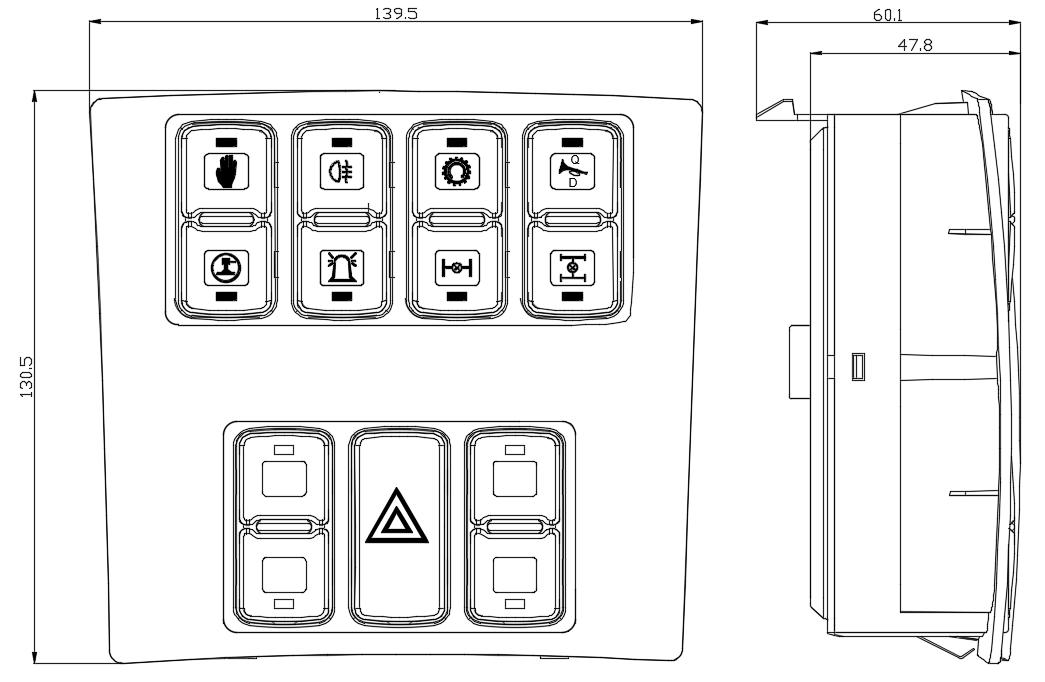
Bus + hard-wire backup architecture
One CAN-bus pair carries every key event to the body-control module, returns the function-lamp commands, and supports software-defined long-press / multi-press behaviours per key. In parallel, a single 24 V / 500 mA hard-wire output is reserved for one safety-critical key — most commonly the hazard / warning function — and gives it a direct, bus-independent path. At 500 mA that output suits an LED tell-tale, a relay coil or a BCM input rather than a full incandescent lamp load (which is switched through the programme's relay or BCM); the point is that the safety-critical key stays live even under a complete bus fault. Wired to OEM specification, the panel keeps minimal bus-side overhead in normal operation and stays degraded-mode-safe under a bus fault.
Quiescent current is held to ≤ 5 mA so the panel does not contribute meaningfully to parked-vehicle battery drain. Voltage drop across the switch elements is held to ≤ 200 mV so that the brightness of the function lamps does not vary visibly with battery state-of-charge — important for programmes where the dashboard is a continuous information surface.
Four-fold protection
- Over-voltage. Input over-voltage protection across the 18–32 VDC range — designed to ride out load-dump and jump-start transients on 24 V systems.
- Over-current. Over-current protection on the hard-wire backup output — guards against a downstream short or stuck-on fault.
- Short-circuit. Short-circuit protection on the backup output — self-recovering once the fault is cleared.
- Thermal. Thermal protection on the backup driver — backs the output off as cab-cavity temperature approaches the +85 °C upper working limit.
Mechanical & key durability
The face-plate carrier is moulded in ABS+PC over a PC/ABS key set, sitting on an FR-4 PCBA carrier with stainless spring contacts for the dome action. Each rocker is rated for > 30,000 actuation cycles with a 5 ± 1.5 N primary force (or 3 ± 1 N for secondary positions where a lighter feel is preferred). Key travel is 2.7 mm total with 1.5 mm of conduction stroke, giving a positive tactile click without the over-travel that wears out lighter-built panels.
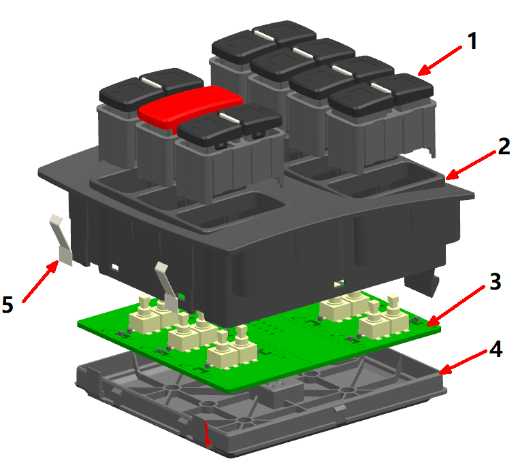
EMC & environmental qualification
The EDK-907 has been validated against the EMC and environmental requirements that major China heavy-truck OEMs apply to dashboard switch panels — including conducted and radiated emissions, electrostatic discharge to the key surfaces, and the temperature and humidity envelope typical of cab interiors. The IP53 sealing is sized for cab-side mounting (front-face spray and dust ingress, not full immersion); panels destined for chassis or exterior mounting move to a different family of products.
Manufacturing & testing
Built under IATF 16949 with APQP project planning and a PPAP package available for OEM programmes. End-of-line testing covers per-key force calibration, conduction-stroke verification, backlight uniformity, and a full CAN-bus packet round-trip against the programme's body-control simulator before packaging. EMC pre-compliance screening is run in our in-house lab against the relevant programme specification.
Choosing the EDK‑907: CAN panel, hard-wired grid, or EDK‑2507
The EDK‑907 earns its place when a cab has enough dashboard functions that a hand-wired rocker grid becomes a harness and diagnostics problem — its keys reporting over one CAN pair instead of eight-to-fourteen individual switch wires through the firewall, with a hard-wire backup kept on the one safety-critical key (typically hazard). For a handful of simple, fixed switches that each have to work independently of any bus, a discrete hard-wired switch — such as the sealed, load-carrying JDK‑2201 3-position toggle — is still the cheaper and simpler answer; the CAN panel pays off once function count, option variants and bus-level diagnostics start to matter. For the interface-level comparison with reference parts on each side, see CAN vs LIN vs hard-wired switches.
Within the Youlai CAN switch family, pick by form factor and mounting:
- EDK‑907 — multi-key rocker panel. An eight-position rocker/key grid for the main cab dashboard, with the 24 V hard-wire backup channel and IP53 cab-interior sealing — the right choice when you are replacing a full switch grid and want one degraded-mode-safe key.
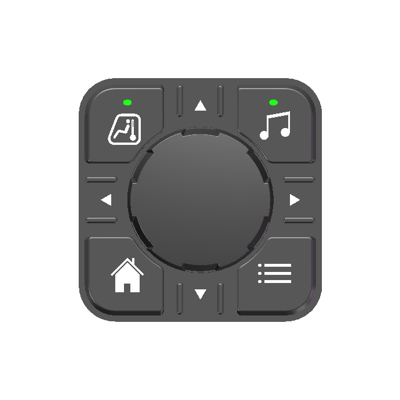
- EDK‑2507 — rotary + four-button controller. A compact rotary-and-button HMI in a higher IP66 seal, rated to 100,000 cycles with 6.8 G vibration / 50 G shock validation — for menu-style control or harsher cab / off-road dashboard environments where a rotary encoder suits the function better than a rocker bank. It is pure CAN, without the hard-wire backup channel.
Youlai also catalogues the EDK‑913 button panel in the same dashboard-switch family — a simpler fixed-key panel built to your console layout. Because it is quoted per programme, confirm its interface (CAN or hard-wired), key count, backlight and sealing at RFQ rather than assuming the EDK‑907's CAN-plus-backup architecture. The TDK‑2420 bus panel switch is a further per-programme member of the same dashboard-panel space; its bus interface (CAN or LIN), function set, sealing and cycle rating are all confirmed at RFQ rather than read across from the EDK‑907. Where a cab genuinely needs bussed diagnostics and a degraded-mode-safe key on one function, the EDK‑907 is the panel to specify.
For the architecture decision behind all of this — CAN versus LIN versus hard-wired switching, who owns the message matrix, and how a panel coexists with the rest of the body bus — see the CAN bus switch panel buyer guide. The body-control module that receives these key messages and drives the loads is covered in the heavy-truck BCM guide.
How to ask
The EDK-907 belongs to the Switches & Sensors family. To request a custom key legend / backlight scheme, the CAN protocol description or a cab-harness-specific connector pinout, use the contact page. These help if you already have them: target cab programme, expected annual volume, and key technical requirements (active key count, backlight colour, CAN baud rate, hard-wire backup function). Drawings welcome.