Overview
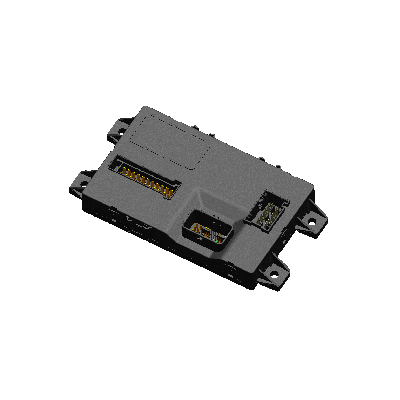
The EBX-2305 is a single-ECU body control module for new-energy commercial vehicles — pure-electric and hybrid buses, light trucks and platform vehicles. It replaces the patchwork of relays, RF receivers and discrete controllers traditionally used for body, lighting, wiper and remote-key functions, and presents the OEM with one validated unit instead.
The integrated 433.92 MHz RF receiver supports both passive entry (PKE) and remote keyfob (RKE) operation, with a typical line-of-sight range of about 20 m. Power-supply tolerance is 9–16 VDC (12 V nominal) with a quiescent current of ≤ 3.5 mA, suitable for vehicles parked off-charge for extended periods.
The EBX-2305 covers RKE and PKE over its integrated RF receiver, but it does not include the LF-antenna localisation and one-touch-start sequencer of a full PEPS controller. For how RKE, PKE and full PEPS differ — and when a programme needs a dedicated PEPS controller such as the 24 V EBX-964 — see the PEPS keyless entry guide.
Integrated functions
The EBX-2305 consolidates four functional groups that are normally spread across multiple controllers:
- Lighting — interior. Dome lamp, ambient / mood lighting, door-warning lamp, start-button and hazard-button indicators, and footwell lamps.
- Lighting — exterior. Turn signal, lane-change, hazard, position lamp, low-beam, high-beam (incl. flash-to-pass), front and rear fog lamps, daytime running lights, brake lamp, reverse lamp, follow-me-home and automatic headlamp control.
- Wiper & washer. Front and rear wiper drive, front and rear washer pumps, plus a wiper service / parking-park mode for harness diagnostics and replacement.
- Smart-key (RKE / PKE). Remote and PKE lock / unlock, tailgate release, vehicle-finder beep, and remote one-touch window up / down — all over the integrated 433.92 MHz receiver.
- Central locking. Driver- and key-side locking, mechanical-key emergency unlock, speed-based auto-lock, high-voltage power-down auto-unlock, crash-signal auto-unlock and lock-motor over-temperature protection.
Engineering details
The 433.92 MHz RF link is specified at TX −35 to +10 dBm with RX sensitivity better than −105 dBm, supporting both ASK and FSK modulation so a programme can pair it with the OEM's preferred keyfob platform. Ground-shift tolerance is ±1 V, which keeps the module operational across the kind of multi-point ground references typical on long-wheelbase commercial chassis.
Mechanically the housing is dust-protected to IP5K0 per GB/T 30038-2013, the road-vehicle adoption of ISO 20653 — the closest IEC 60529 equivalent is IP5X, with no liquid-ingress test required. For installations exposed to wash-down or direct splashing, please specify at quotation; sealed variants in the same family are available on request.


Manufacturing & testing
Built under IATF 16949 with APQP project planning and a PPAP package available for OEM programmes. Every unit is end-of-line functional-tested before packaging — RF link budget, current draw and the lighting / locking I/O matrix are all checked. Environmental validation and EMC pre-compliance screening in our in-house lab is run when the programme requires it; the module is designed for the GB/T 30512-2014 RoHS-equivalent scope.
How to ask
The EBX-2305 belongs to the Smart Control Modules family. To request the harness drawing, RF protocol details or a PPAP package, use the contact page. These help if you already have them: target vehicle programme, expected annual volume and key technical requirements (CAN protocol if any, IP rating, working temperature, connector preference). Drawings welcome.