Overview — the final electrical safety stop on an HV traction pack
On a modern electric commercial vehicle, the high-voltage traction pack is a 400-1100 VDC energy reservoir holding hundreds of kilowatt-hours of stored energy. Most of that energy is safely managed by the battery-management system (BMS), the high-voltage interlock loop and the contactor relays inside the pack — but in the worst-case fault scenario where a short-circuit develops downstream of the contactors (a wiring insulation failure, a sustained external short on the bus busbar, an internal cell short propagating through the module), the fault current can climb tens of kiloamps in milliseconds. At that fault scale, even the fastest electronic interlock cannot interrupt the bus safely — the only reliable mechanism is a mechanical-thermal fuse element rated for the worst-case breaking capacity.
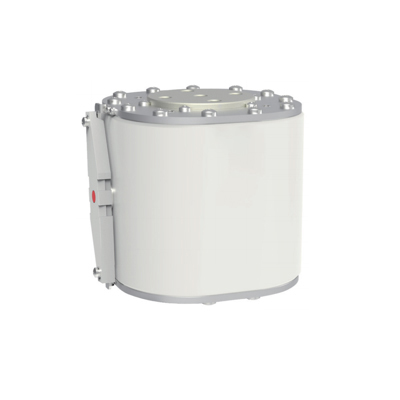
The JDK-2509 is that fuse element. Sized for the worst-case 250 kA fault current at 1500 VDC, the JDK-2509 sits in-line on the traction-pack DC bus (typically between the pack-side contactor and the downstream HV distribution box) and acts as the final electrical safety stop — the component that interrupts the bus when every other safety mechanism has failed or is responding too slowly. Compliant with the dedicated IEC 60269-7 standard for EV fuses (and its Chinese counterpart GB/T 13539.7); the short-circuit type test is conducted at a TÜV-accredited laboratory for European OEM dossier acceptance.
Engineering details
aBat utilisation category — the dedicated EV-battery fuse class
The aBat utilisation category (IEC 60269-7) is the dedicated EV-battery fuse class introduced specifically for traction-pack protection on electric vehicles. It covers the fault-current envelope from low-overload faults (typically 2-5× rated current, slow-developing) through to the catastrophic short-circuit faults at the rated breaking capacity, on a battery DC bus. Other fuse categories (gG, aR, gR) are sized for sub-ranges of the AC or DC fault envelope and are not specified for the EV-battery duty profile. The JDK-2509 carries the aBat category designation per IEC 60269-7.
250 kA breaking capacity & IEC 60269-7 test methodology
The headline rating is 250 kA breaking capacity at 1500 VDC. To put that in scale: a single high-energy battery cell can discharge tens of kiloamps into a hard external short during its first millisecond — a 1-megawatt-class commercial-vehicle traction pack scales that to the 100-kA-plus range. The JDK-2509 is sized to interrupt that fault current within the IEC 60269-7 type-test envelope. The standard's short-circuit type test characterises the test circuit by an L/R time constant of 1-3 ms (this is the test-circuit characterisation parameter from the standard's test methodology, not the fuse's interruption time). Successful clearing within that test envelope helps the upstream battery-management chain contain the fault before the battery-cell internal temperature rise can develop into a thermal event.
5 × M12 terminal bolt array for high-current contact area
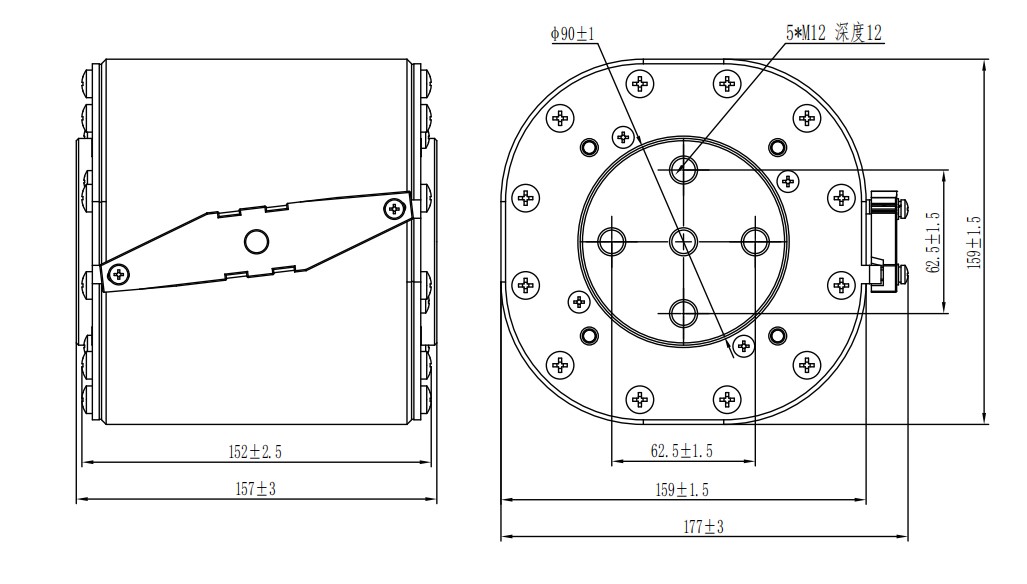
The continuous-current rating of 1250-3000 A is set by the terminal-side contact area. The JDK-2509 distributes the terminal interface across a 5-bolt M12 array on the end face (12 mm bolt-engagement depth, Φ90 mm centre busbar conductor path) — the 5-bolt distribution provides the contact-area capacity to maintain the rated current with safe terminal-side heating, and gives the integrator the flexibility to land thick OEM-side copper busbars without exceeding the contact-pressure-per-bolt envelope. The mating busbars and terminal stand-offs are specified per OEM programme drawing.
Mechanical striker for visual fault indication
A built-in mechanical striker (visible at the centre of the side face in the product photo) protrudes when the fuse element interrupts — the workshop technician can confirm the fuse has operated from a metre away, without removing the protective HV cover and without electrical interrogation. The striker is a standard requirement on the highest-grade EV fuse category and is built into the JDK-2509 by design. Striker-tripped output can also be wired into the BMS isolation-monitor circuit for automatic vehicle disable on fault.
Mechanical drawing — side view + end view
Where the JDK-2509 fits in the Youlai new-energy power chain
The JDK-2509 is the fuse-side safety component that completes the Youlai new-energy power-conversion family on the protection axis. Where the rest of the family handles power conversion at progressively lower voltage / power tiers (HV→24V via EBX-2314 at 36 kW or EBX-2512 at 6 kW, HV→AC via EBX-2514 at 30 kW Vehicle-to-Load, 24V→12V via EBX-2407 with dual-battery balancing), the JDK-2509 protects the HV input side of all of those converters — the single component that interrupts a downstream catastrophic short before it can damage the rest of the conversion chain, helping the upstream battery-management chain contain the fault on the cell-stack side.
The 1500 VDC rating gives the JDK-2509 the headroom to protect every commercial-vehicle traction-pack class in service today (400 V class, 600 V class, 900 V class, 1100 V class), and the 1250-3000 A continuous current envelope covers the full sizing range from a mid-duty new-energy commercial vehicle (1250-1600 A typical) up to a heavy-duty long-haul electric truck or electric construction machine (2000-3000 A typical, with the family extending to 4000 A continuous for the largest-bus-current applications).
Manufacturing & testing
Built under IATF 16949 with APQP project planning and a PPAP package available for OEM programmes. The fuse-element design is qualified to the IEC 60269-7 aBat envelope; short-circuit type testing is conducted at a TÜV-accredited laboratory. Every production unit is end-of-line continuity-tested and visual-inspected (terminal-bolt thread quality, ceramic-body cosmetic check, striker movement check, marking accuracy). The TÜV test report and the IEC 60269-7 aBat type-test report are available on PPAP request for OEM dossier inclusion.
How to ask
The JDK-2509 belongs to the Switches & Sensors family (DC Isolators, HV Fuses & Discrete Sensors grouping). To request the SKU-specific continuous-current rating (1250 / 1400 / 1600 / 1800 / 2000 / 2500 / 3000 A typical), the OEM-side busbar drawing and contact-pressure specification, the striker-status electrical-interrogation option, or the TÜV test report / PPAP dossier, use the contact page. These help if you already have them: target vehicle programme, traction-pack nominal voltage, expected continuous bus current and worst-case short-circuit fault envelope. Drawings welcome.