Overview — the combiner HUD architecture
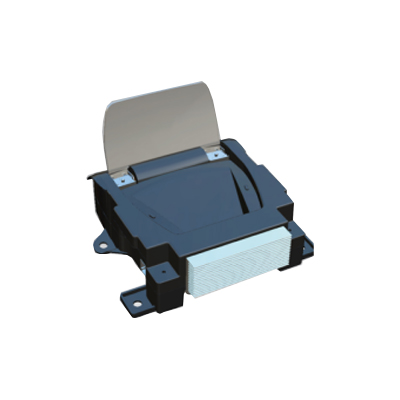
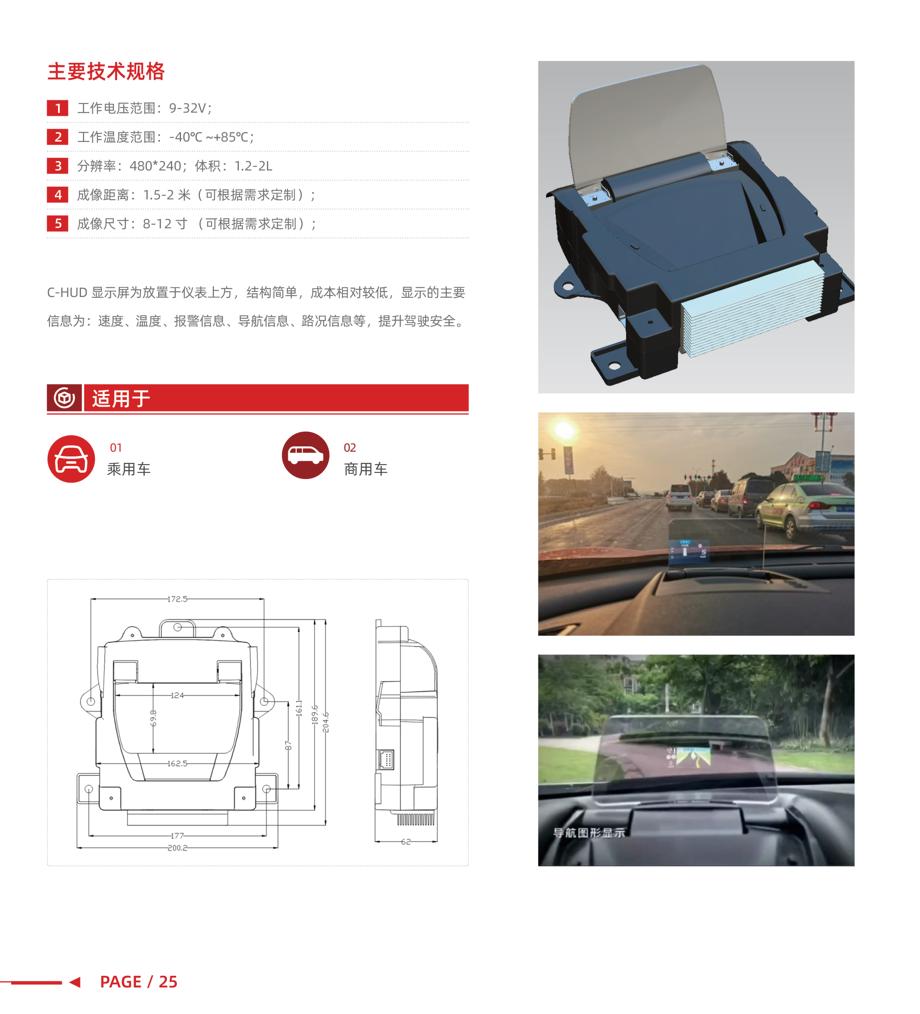
A combiner HUD (C-HUD) is the simpler of the two mainstream HUD architectures. Instead of projecting onto the windscreen (which forces the optical designer to compensate for the windscreen's complex curvature, its varying tint and the asymmetric eye-box), a combiner HUD projects onto a small fold-up combiner glass mounted on the top face of the HUD enclosure, directly in the driver's line of sight. The combiner glass is purpose-designed for HUD use — uniform thickness, anti-reflection coatings tuned to the projection wavelength, and a small enough footprint that the optical correction problem reduces from "compensate for a complex 3D windscreen surface" to "compensate for a clean 2D combiner glass". The result is a meaningfully simpler optical stack, a smaller image at a shorter projection distance, but at a lower cost and a smaller enclosure than the windshield-projection equivalent.
The PBX-2203 is the entry-level of the Youlai HUD line, positioned for OEM programmes that want HUD functionality without the cost / installation overhead of a windshield projection. The combiner architecture is also windscreen-rake-agnostic — because the projection target is the combiner glass on the HUD itself (not the windscreen), the same C-HUD product adapts across cab geometries that would need separate windshield-projection optical tunings on a W-HUD product.
Engineering details
480 × 240 TFT image generator
The image generation side uses a 480 × 240 TFT panel — modest resolution by modern display standards, but well-matched to the C-HUD use case. The HUD content shown to the driver is purpose-engineered for readability at the projection distance, not photo-realism: a large speed read-out, large directional turn-by-turn arrows, large alarm icons. A 480 × 240 panel renders all of these cleanly with the headroom to drive the combiner-glass projection at the brightness needed for daylight readability. Higher-resolution panels add cost without adding meaningful information density at this image size and projection distance.
Compact 1.2-2 L enclosure
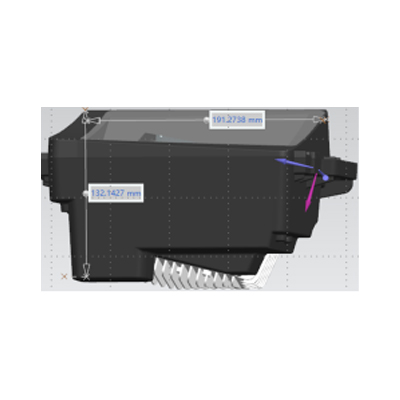
The full HUD assembly fits inside a 1.2-2 L enclosure (the lower end covers the 8" image configuration, the upper end covers the 12" image configuration), with a typical footprint of roughly 172.5 mm × 200.2 mm on the dash top. The fold-up combiner glass mounts on the upper face of the enclosure and folds flat when the HUD is not in use, so the dash-top profile during the day is minimal and the driver's forward sight-line is unobstructed when the HUD is folded down.
9-32 V wide-range input
The 9-32 VDC input range is sized to accept a 24 V commercial-vehicle cab installation with the typical voltage swing seen during alternator-side load events, plus 12 V supply-range installations (light-duty cab or aftermarket fitment). The wider input range on the PBX-2203 (versus the 18-32 V range on the higher-end PBX-961 W-HUD) reflects the broader programme fit of the combiner HUD — 12 V installations routinely encounter the lower end of the input range, and the 9-32 V envelope eliminates the need for a 12 V / 24 V product variant.
HUD content set
The PBX-2203 renders the standard commercial-vehicle HUD content set:
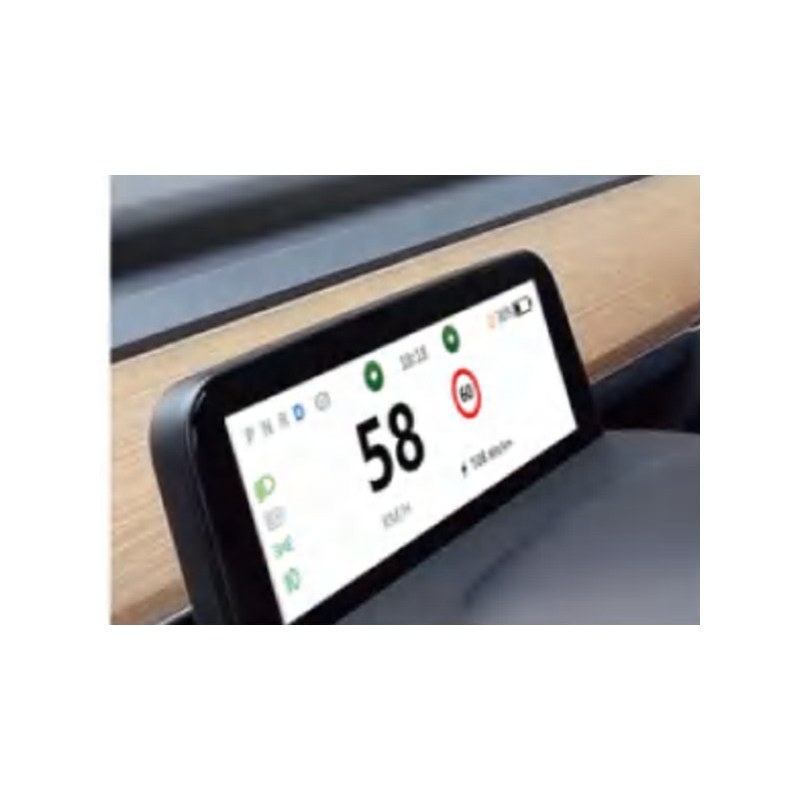
- Speed — the primary HUD read-out, large central numeric display
- Cab temperature — secondary read-out, small numeric display in a corner of the projection
- Alarm messages — raised on the HUD when a cab system reports a fault, so the driver sees the alarm without taking the eye off the road to read the cluster warning lights
- Navigation prompts — turn-by-turn directional arrows from the navigation source in the cab, with the next-turn distance rendered alongside the arrow
- Road-condition prompts — speed-limit changes, congestion warnings and weather-driven advisories, from whichever upstream source the programme nominates
Mechanical envelope — combiner-glass dimensions and 3D model
Comparison with the PBX-961 W-HUD
| Model | HUD type | Image size | Projection distance | Working voltage | Cost / programme fit |
|---|---|---|---|---|---|
| PBX-2203 | C-HUD (combiner glass) | 8-12" (customisable) | 1.5-2 m | 9-32 VDC | Entry-level — mounts above cluster, windscreen-rake-agnostic, lower-cost |
| PBX-961 | W-HUD (windshield) | 15" (customisable) | 2.4 m | 18-32 VDC | Higher-end — dash-top installation, windscreen-tuned optical stack, dual free-form mirror |
The PBX-2203 is the right choice when the programme needs HUD functionality at the entry-level cost point, when the cab geometry does not permit the dash-top installation envelope of a W-HUD, or when the OEM needs HUD compatibility across cab geometries that would otherwise require separate W-HUD optical tunings. For programmes where the OEM wants the larger virtual image and longer projection distance of a windscreen-projected HUD, the PBX-961 W-HUD is the higher-end alternative in the same line.
Manufacturing & testing
Built under IATF 16949 with APQP project planning and a PPAP package available for OEM programmes. Every unit is end-of-line functional-tested before packaging — the TFT image generator pixel-test, the back-light intensity calibration, the combiner-glass alignment, the fold-up hinge mechanical-action cycle, the projection geometry on a calibrated test bench and the rear connector pin-continuity. Per-programme the image content layout (speed read-out size, navigation-prompt placement, alarm-icon library) is configured at first-article qualification to match the signal list agreed for the programme.
How to ask
The PBX-2203 belongs to the Displays & HUD family. To request the cab-geometry questionnaire (eye-box position, dash-top cavity envelope, cluster-top installation point), the projection-image specification (virtual image size, projection distance, content layout), the signal list for the speed / navigation / alarm content, the rear-harness drawing or a PPAP package, use the contact page. These help if you already have them: target vehicle programme, expected annual volume and target installation envelope. Drawings welcome.