Overview — why a windshield HUD on a commercial vehicle
On a passenger car, a HUD is a comfort feature; on a commercial vehicle the calculus is different. The typical heavy-truck driver covers 8-12 hours of seat time per shift, often with a route mix that interleaves dense city sections (high blind-zone exposure, frequent speed-limit changes) and long-haul highway sections (monotony-driven fatigue, lane-keeping degradation). The single most-quoted ergonomics finding in commercial-vehicle cab studies is that cutting the eye-down accommodation cycle (the small but constant glance from road to cluster and back) shortens the re-focusing time between the road and the displayed information — driving-simulator literature (e.g. SAE 960946 and follow-on Human Factors studies) reports reduced glance dwell and reduced cognitive load when essential driving information is rendered in the windshield projection plane rather than down at the cluster. A windshield HUD does both at once — the projected image sits at convergence distance similar to the road ahead, so the driver does not need to re-focus the eye between road and HUD content, and the speed / navigation / ADAS content reaches the driver without taking the eyes off the road.
The PBX-961 is the windshield (W-HUD) end of the Youlai HUD product line, intended for OEM programmes where the cab packaging budget permits a dash-top projection enclosure and the windscreen rake supports the upward projection path. For programmes that need a HUD but cannot accommodate a dash-top projection enclosure (or where the cost / packaging constraints favour a combiner glass over a windshield projection), the PBX-2203 C-HUD is the simpler entry-level alternative.
Engineering details
Why W-HUD on a commercial vehicle cannot be fully recessed
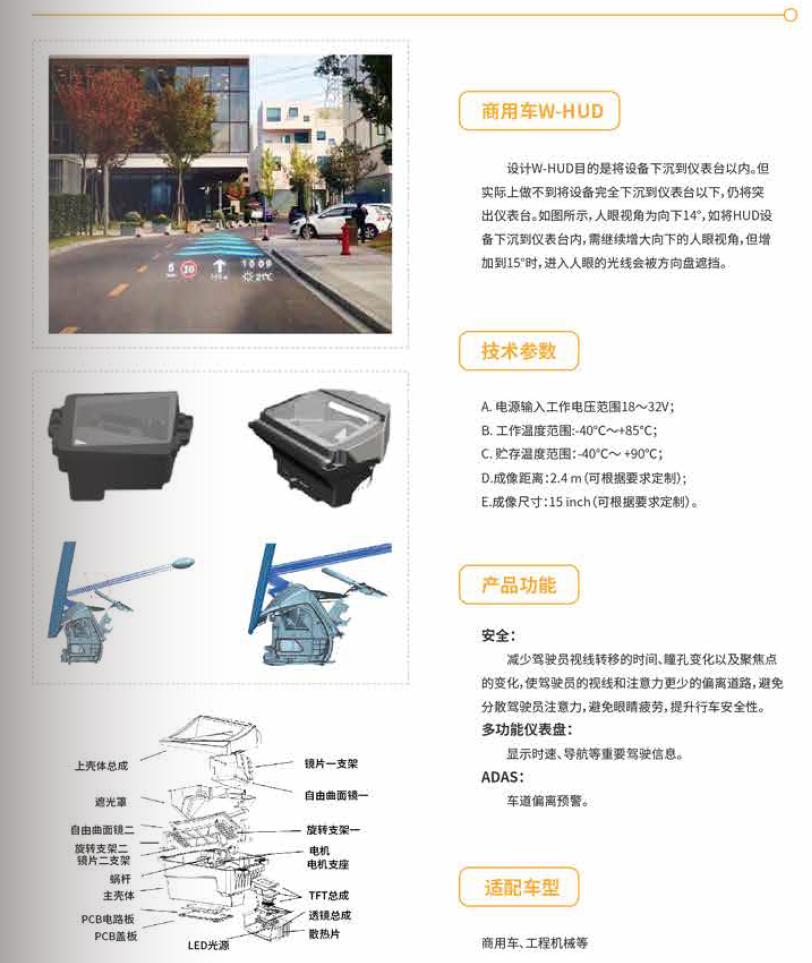
One question that comes up repeatedly in early programme reviews is whether the HUD enclosure can be recessed entirely below the dash cut-line, so that no part of the projection box sits proud of the dashboard. The answer is no, and the geometry of why is straightforward enough to derive at the cab-design stage: in a typical commercial-vehicle driver position the eye-down angle to the road ahead is roughly 14° below horizontal. A fully-recessed HUD requires the projection ray to start below the dash cut-line, which forces the eye-down angle further (toward 15° or steeper) for the driver to see the projected image. At that eye-down angle the steering-wheel rim begins to intrude on the projection path and occlude part of the projected image. The PBX-961 enclosure is therefore sized to project from a dash-top installation — the enclosure body sits proud of the dashboard, with the projection face pointing upward toward the windscreen at the geometry that keeps the steering-wheel rim out of the projection path.
Dual free-form mirror optical stack
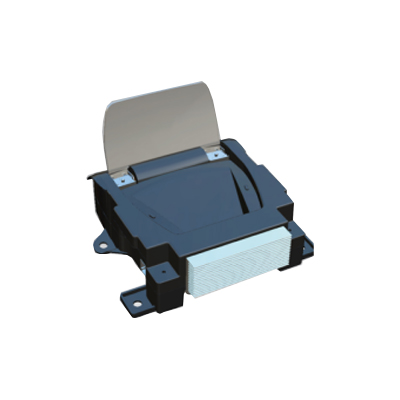
The PBX-961 uses a dual free-form mirror design for the projection path. Free-form mirrors (mirrors whose surface is not constrained to a sphere, cylinder or other classical conic section) are the preferred mirror geometry for HUD optics because they let the optical designer correct multiple aberrations simultaneously — image distortion, ghosting, brightness uniformity across the field of view, and chromatic aberration — in a way that classical mirror geometries cannot. The first free-form mirror handles the primary projection bend; the second free-form mirror folds the projection path to fit the compact dash-top enclosure envelope. A motorised rotation stage on the second mirror lets the driver adjust the viewport elevation to match seat-height preference, with the rotation envelope tuned to the typical driver-seat travel range on commercial-vehicle programmes.
LED light source + TFT image generator
The image-generation side uses an LED light source illuminating a TFT panel (the equivalent of the back-light + LCD architecture used on a conventional dashboard cluster, optimised here for HUD luminance). LED + TFT is the volume-favoured architecture for commercial-vehicle HUD programmes because the cost, supply chain and brightness tunability are all well-understood (versus DLP or LCoS imager architectures that are more common at the passenger-car luxury end of the market). A dedicated heat-sink on the LED + TFT assembly handles the thermal load — HUD imagers run hot under sustained full-brightness operation, and the heat-sink keeps the panel and LED in their rated operating temperature envelope even during prolonged daylight-readability conditions.
Compact 2.75 L enclosure
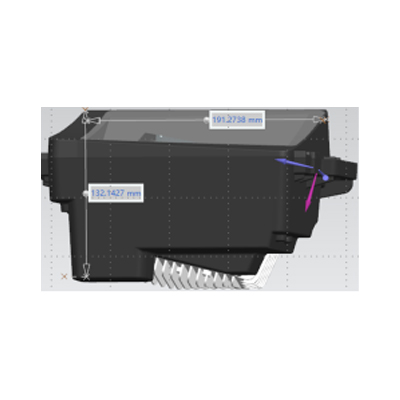
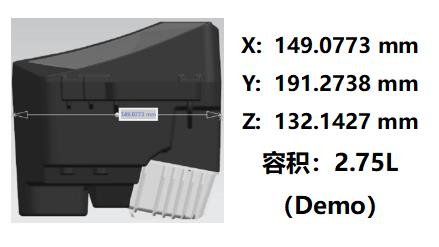
The full optical + electronics stack fits inside a 149 × 191 × 132 mm enclosure for a 2.75 L internal volume — compact enough to install on the dash-top of a typical commercial-vehicle cab without forcing a major dashboard rework. The enclosure body carries integral mounting feet for bolt-down to the dash structure, with the rear connector area positioned at the back of the enclosure for cable strain relief routing back into the dash cavity.
What gets shown on the HUD
The W-HUD content on commercial-vehicle programmes today falls into three categories, all of which the PBX-961 is engineered to render:
- Driver-attention ergonomics — the primary ergonomic benefit comes from cutting the eye-down accommodation cycle that a conventional cluster requires; driving-simulator studies report reduced glance dwell and reduced cognitive load when speed, navigation and ADAS prompts sit in the windshield projection plane rather than down at the cluster
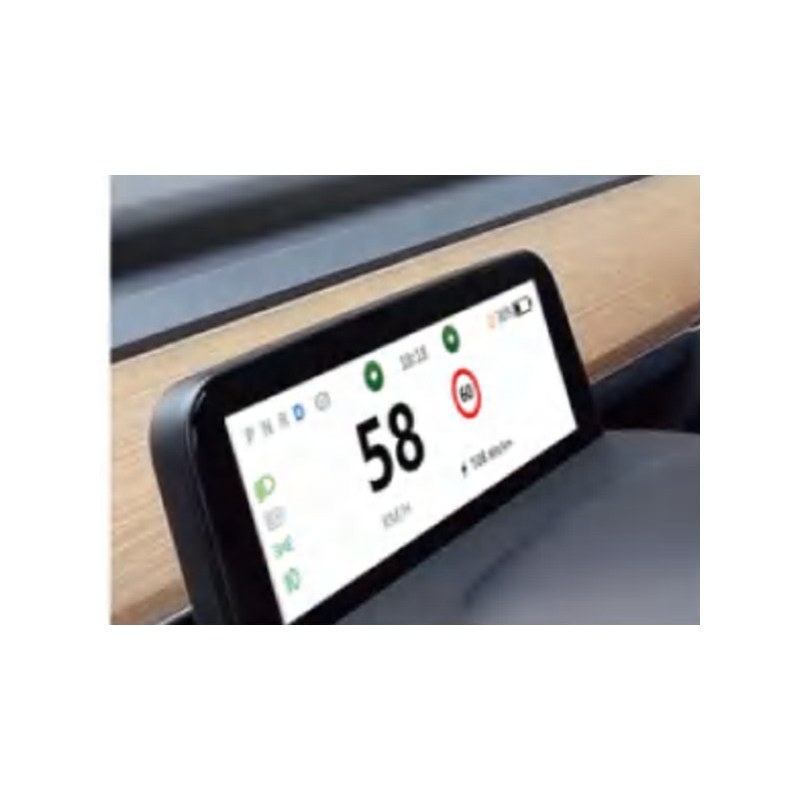
- Multi-function cluster info — the everyday speed read-out and turn-by-turn navigation prompts (rendered with directional arrows in the projected image, matched to map data dispatched over the vehicle bus)
- ADAS — lane-departure warning dispatched onto the projection layer as a high-visibility prompt without requiring the driver to look down at the cluster (the standard rendering shows a directional warning toward the side of departure with an attention-getting colour and motion cue)
All content is dispatched onto the HUD over the vehicle bus from upstream sources (the cluster ECU, the navigation head-unit or the ADAS ECU); the PBX-961 is the rendering surface, not the source of the content.
Mechanical envelope
Internal architecture — exploded view of the optical / image-generation stack
Comparison with the PBX-2203 C-HUD
| Model | HUD type | Image size | Projection distance | Optical complexity | Cost / programme fit |
|---|---|---|---|---|---|
| PBX-961 | W-HUD (windshield) | 15" (customisable) | 2.4 m | Dual free-form mirror + motorised stage + LED + TFT | Higher — dash-top installation, requires windscreen-rake compatibility |
| PBX-2203 | C-HUD (combiner) | 8-12" (customisable) | 1.5-2 m | Combiner glass + LED + TFT (480×240 image generator) | Entry-level — mounts above cluster, simpler installation |
The PBX-961 is the right choice for programmes where the OEM wants a windscreen-projected HUD with a large virtual image, accepts the dash-top installation envelope, and is willing to invest in the more complex optical stack. For programmes that need a HUD but cannot accommodate the dash-top installation (or where the budget favours a simpler combiner-glass solution), the PBX-2203 C-HUD is the entry-level alternative in the same line.
Manufacturing & testing
Built under IATF 16949 with APQP project planning and a PPAP package available for OEM programmes. Every unit is end-of-line functional-tested before packaging — the LED light source intensity calibration, the TFT image-generator pixel-test, the dual free-form mirror alignment, the motorised viewport rotation full-range travel, the projection geometry on a calibrated test windscreen, the rear connector pin-continuity and the enclosure-sealing pressure test. Per-programme the projection optics are tuned at first-article qualification to match the actual cab windscreen rake, eye-box position and bonnet-line height.
How to ask
The PBX-961 belongs to the Displays & HUD family. To request the cab-geometry questionnaire (eye-box position, windscreen rake, bonnet-line height, dash-top cavity envelope), the projection-image specification (virtual image size, projection distance, content layout), the CAN signal mapping for speed / navigation / lane-departure ADAS, the rear-harness drawing or a PPAP package, use the contact page. These help if you already have them: target vehicle programme, expected annual volume and cab-geometry constraints. Drawings welcome.