Overview — one annunciator for three modern-vehicle alert functions
A modern electric or ADAS-equipped commercial vehicle has three audible-alert function classes that need an exterior-mounted speaker, and on a lot of older designs each function ended up with its own dedicated buzzer:
- An AVAS (Acoustic Vehicle Alerting System) speaker for the electric-vehicle low-speed pedestrian-warning sound — mandated on most EV markets because the typically-silent electric drivetrain is dangerously inaudible to pedestrians and cyclists at low speed (and especially dangerous for visually-impaired pedestrians).
- A turn-signal audible alert speaker for the outside-the-cab "ding-ding-ding" pulse synchronised to the turn-signal flash — helpful for the bicyclist / pedestrian / following car behind the vehicle who would otherwise not notice the turn-signal lamps, especially in bright sunlight or from an oblique angle.
- A blind-spot audible alert speaker for the side-mirror-side annunciation that fires when the ADAS BSD (Blind Spot Detection) catches a vehicle in the adjacent-lane blind zone — warning the next-lane bicyclist / motorcyclist / car driver that the truck is about to change lane in their direction.
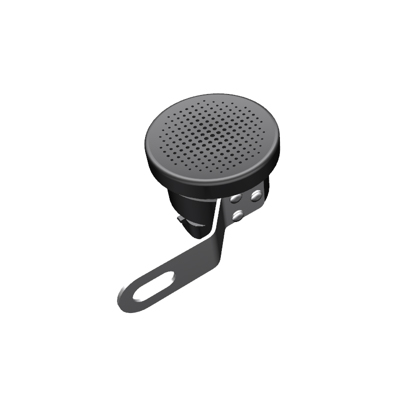
The EBX-2406 collapses all three into one speaker module. The same hardware handles all three alert function classes; the upstream ECU just sends the alert-class message on the CAN bus and the EBX-2406 plays the corresponding clip. A single SKU instead of three different speaker SKUs, one cable instead of three, one mounting bracket instead of three. The base "ding-ding-ding" tone runs at 85 ± 3 dB SPL, the configurable AVAS clip profile and per-class cadence give the OEM the flexibility to tune the alert per vehicle category, and the wide 9-36 VDC supply means the same SKU works on both 12V and 24V platforms.
Function classes walk-through
1. AVAS engine-sound emulation
The AVAS function class plays the configured low-speed pedestrian-warning sound clip when the vehicle is within the AVAS speed window (typically 0–30 km/h, configurable at quotation per the host vehicle's AVAS profile). The host vehicle's VCU dispatches the AVAS-class message on the CAN bus with the current vehicle speed; the EBX-2406 modulates the playback amplitude as a function of vehicle speed per the AVAS profile (silent at full stop, ramp-up across the low-speed window, fade-out above the AVAS speed ceiling where conventional tyre / wind noise takes over). The 2-pin always-on supply path keeps the AVAS speaker alive even if the upstream ECU goes into a transient low-power state — the AVAS function class must not drop out at low speed for safety reasons.
2. Turn-signal audible alert
The turn-signal alert function class plays a pulse synchronised to the turn-signal flash whenever the host vehicle's turn-signal lamps are active. The pulse cadence matches the turn-signal flash cadence (typical 1.5 Hz), and the alert continues for as long as the turn-signal is on. The upstream ECU dispatches the turn-signal-active CAN message with the active-direction (left / right) field; on a vehicle with two EBX-2406 modules (one per side), each module subscribes only to its own side's turn-signal message for the natural left-alert-from-left-side / right-alert-from-right-side behaviour.
3. Blind-spot audible alert
The blind-spot alert function class fires when the ADAS BSD (Blind Spot Detection) sub-system sees an obstacle in the adjacent-lane blind zone. The alert intensity / cadence can be tuned per the BSD severity classification (typical "object-detected" tone vs "collision-imminent" higher-intensity tone), with the BSD ECU dispatching the BSD-class CAN message with the severity field. The same per-side selectivity as the turn-signal alert applies — a left-side EBX-2406 module annunciates only the left-side BSD events.
Engineering details
- Three alert function classes on one hardware — AVAS pedestrian warning + turn-signal alert + blind-spot alert dispatched from the CAN bus on a single speaker module; eliminates the need for three different speaker SKUs
- Two separate sealed connectors — the 2-pin always-on supply path for the safety-critical AVAS function class, plus the 4-pin power + CAN path for the ignition-gated supply and the alert-class CAN dispatch
- 85 ± 3 dB SPL acoustic output — audible to the pedestrian / cyclist within the typical low-speed-warning envelope; per-class playback amplitude tuned through the configured clip profile
- Configurable per-class clip profile — the AVAS clip, the turn-signal cadence and the blind-spot tone are all configurable at quotation per the host vehicle programme
- Wide 9-36 VDC supply — same SKU usable on 12 V and 24 V platforms without a separate part number
- ESD level 4 / class A — sized for the exterior under-vehicle placement where the ESD environment is more aggressive than the cabin baseline
- IP5K2 housing per ISO 20653 — dust-protected and drip-protected; suitable for sheltered exterior placement (typically under-bumper or front-skirt, or a sheltered chassis-side bracket); not for direct wheel-spray or high-pressure-wash paths
- Integrated stainless-steel L-bracket — direct chassis-side mounting without an external bracket adapter; bracket slot accommodates M-class mounting bolts and lets the installer adjust the angle for the typical chassis-side bracket geometry
- TE Deutsch connector pair — industry-standard sealed connectors with wide global availability for the matching wire-side housing, terminals and seals
Connector pin-out reference
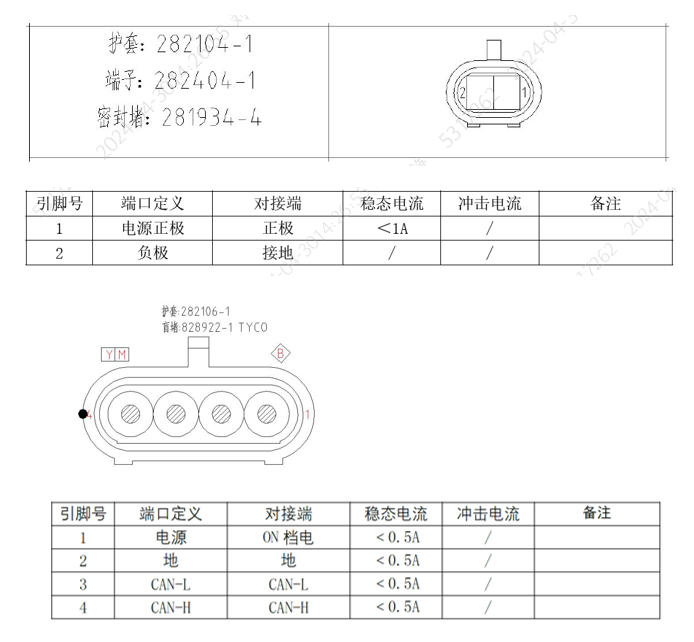
| Connector | Pin | Definition | Counterpart | Steady-state current |
|---|---|---|---|---|
| 2-pin power-in (TE 282104-1) | 1 | Power positive (always-on, battery direct) | Battery positive | < 1 A |
| 2 | Negative / GND | GND | — | |
| 4-pin power + CAN (TE 282106-1) | 1 | Power (ON / KL15 ignition-gated) | ON / KL15 | < 0.5 A |
| 2 | GND | GND | — | |
| 3 | CAN-L (alert-class dispatch from upstream ECU) | CAN-L | < 0.5 A | |
| 4 | CAN-H | CAN-H | < 0.5 A |
Comparison with related Youlai annunciator / audible modules
| Model | Domain | Function | Dispatch path |
|---|---|---|---|
| EBX-2406 | Exterior speaker | AVAS + turn-signal + blind-spot (3 classes on 1 hardware) | CAN bus (alert-class message) |
| EBX-2404 | Cabin-side wireless receiver | Bus stop-request + accessibility-button reception | RF reception → low-active digital output |
| EBX-963 | Dump-truck body controller | Body controls + horn drive for security annunciation | Direct horn relay drive |
The EBX-2406 is the right choice for an exterior-mounted multi-function annunciator on a modern electric or ADAS-equipped vehicle. For the cabin-side wireless reception of passenger stop-request and accessibility buttons, look at EBX-2404; for the simpler direct horn-relay drive integrated into a body controller, look at EBX-963.
Manufacturing & testing
Built under IATF 16949 with APQP project planning and a PPAP package available for OEM programmes. Every unit is end-of-line functional-tested before packaging — the 85 ± 3 dB SPL acoustic output measurement (with the standard "ding-ding-ding" test clip at the calibrated distance), the playback of each of the three alert function clips at the configured cadence and amplitude, the CAN bus health on the 4-pin connector path, the 2-pin always-on supply baseline current draw, the 4-pin ignition-gated supply baseline current draw, the IP5K2 ingress baseline and the ESD level 4 immunity surface are all checked.
How to ask
The EBX-2406 belongs to the Smart Control Modules family. To request the harness drawing, the AVAS clip profile catalogue, the per-class playback cadence options, the per-side selectivity firmware variant, the CAN message-ID assignment or a PPAP package, use the contact page. These help if you already have them: target vehicle programme, expected annual volume and key technical requirements (AVAS speed window per host vehicle programme, turn-signal flash cadence, BSD severity classification levels, mounting position, IP rating). Drawings welcome.