Overview
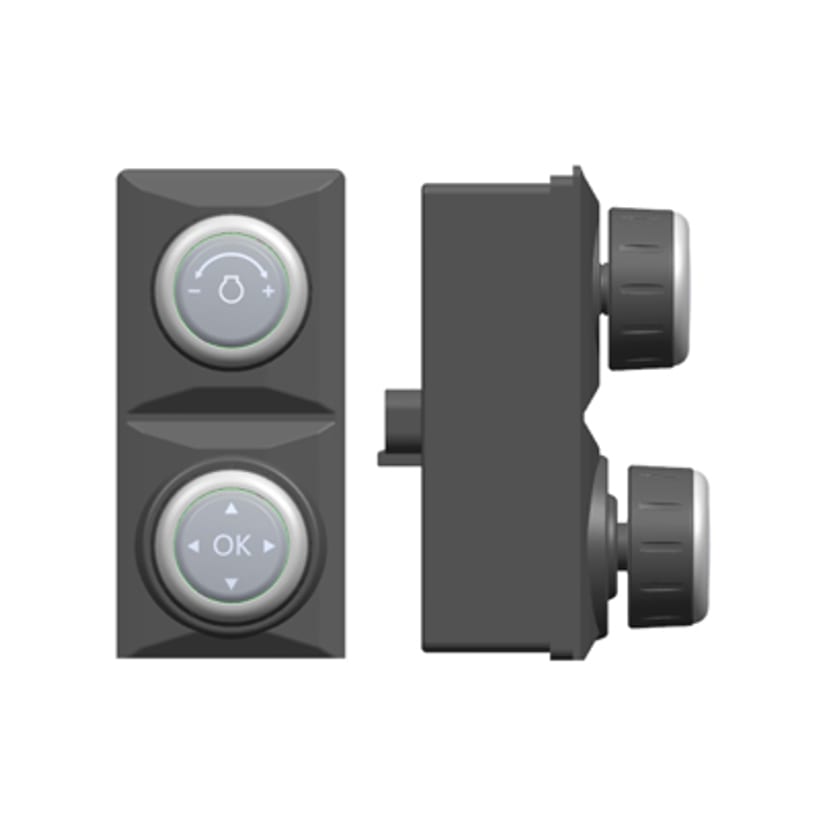
The EDK-2403 puts two rotary-push knobs into a single sealed module that talks to the rest of the vehicle over CAN. Instead of running a cluster of switch lines back to a body controller, the OEM harness only needs four wires: +24 V supply, ground, CAN H and CAN L. Each rotation step, four-way push and centre press is reported on the bus, so the whole control reads as one ECU node.
Mechanically the EDK-2403 is built for the 24 V commercial-vehicle dashboard: IP65 sealing at the panel interface and a low ≤ 5 mA quiescent draw so it can stay live on the bus without loading the battery. It measures 127.6 × 59.6 × 39.1 mm and mounts on four M5 threaded studs on the rear face.
The two knobs
Both knobs share the same tactile spec — continuous rotation with a 15° detent, 450 ± 100 gf·cm rotary torque, and a full-knob press that self-returns — but they carry different roles:
- Navigation knob. Rotate to scroll, push in any of four directions (up / down / left / right) to move through a menu, and press the whole knob to confirm (“OK”). This suits stepping through a cluster menu or picking from a list.
- Control & start knob. Rotate to step a value up or down, and press the knob to send a start request. In the reference configuration this knob adjusts a throttle / drive-level setting and acts as a press-to-start control.
Because the switch communicates over CAN, the assigned function of each knob, the on-screen behaviour and the printed legend are all defined per OEM programme — the hardware provides the rotate / four-way / press inputs, and the vehicle controller decides what each one does. A press-to-start input in particular is a request on the bus; start authorisation, immobiliser logic and any throttle mapping stay in the vehicle’s own controllers. Confirm the message set and safety interlocks for your programme at quotation.
Electrical interface
The EDK-2403 talks to the vehicle over four wires; the harness plugs in with a 4-pin Deutsch DT06-4S mating connector. The pin map is:
- Pin 1. +24 V supply (operating range 18–32 VDC).
- Pin 2. Ground.
- Pin 3. CAN L.
- Pin 4. CAN H.
The switch draws ≤ 5 mA quiescent and is rated Level 4 / Class A for ESD. CAN baudrate and the message-ID layout are configured per OEM specification — confirm at quotation.
Manufacturing & testing
Built under IATF 16949 with APQP project planning and a PPAP package available for OEM programmes. End-of-line testing follows the programme’s control plan — typically CAN-message verification and a rotary / press functional check — while IP65 sealing, EMC and environmental soak are validated on a sample basis in our in-house lab, with certified testing at accredited third-party laboratories when the programme requires it. Materials meet RoHS and a UL94-HB flame rating.
Choosing the EDK-2403: dual rotary, four-button rotary, or a rocker panel
The EDK-2403 is the right pick when the dashboard job is rotary control and menu navigation — scrolling a cluster, stepping a drive or climate level, and confirming with a centre press — and when one of those knobs also needs to double as a start / drive-level control. Its IP65 sealing lets it sit in a more exposed cab or off-road dashboard position than a typical IP53 cab panel.
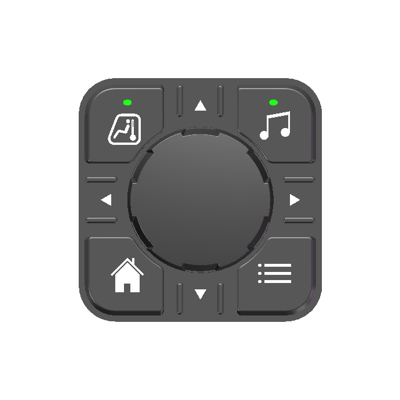
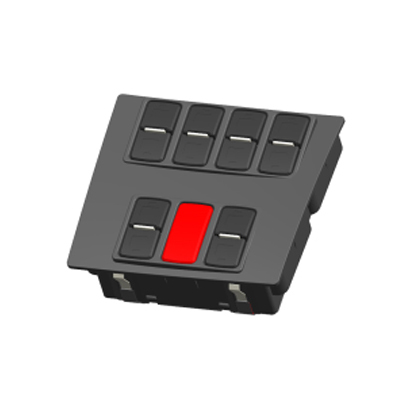
If the job is mostly menu selection with a few discrete buttons, the EDK-2507 four-button CAN rotary switch pairs four legended buttons and four directional side-pushes with a single rotary encoder — better when you need labelled one-touch functions alongside the dial. Where the cab instead needs many labelled, always-on functions — work lights, beacons, PTO, diff-lock — the EDK-907 CAN rocker panel gives one key per function, with a 24 V hard-wire backup channel on the safety-critical key. The EDK-2403 and EDK-2507 report over CAN on a compact 4-pin connector; the EDK-907 uses a larger 14-pin connector that carries the hard-wire backup alongside CAN. For the architecture-level trade-off between CAN panels and hard-wired switching, see the CAN bus switch panel guide.
How to ask
The EDK-2403 belongs to the Switches & Sensors family. To request the dashboard cut-out drawing, custom knob artwork or a CAN-message specification, use the contact page. These help if you already have them: target vehicle programme, expected annual volume and key technical requirements (CAN baudrate, knob function mapping, custom legend, connector preference). Drawings welcome.