Overview
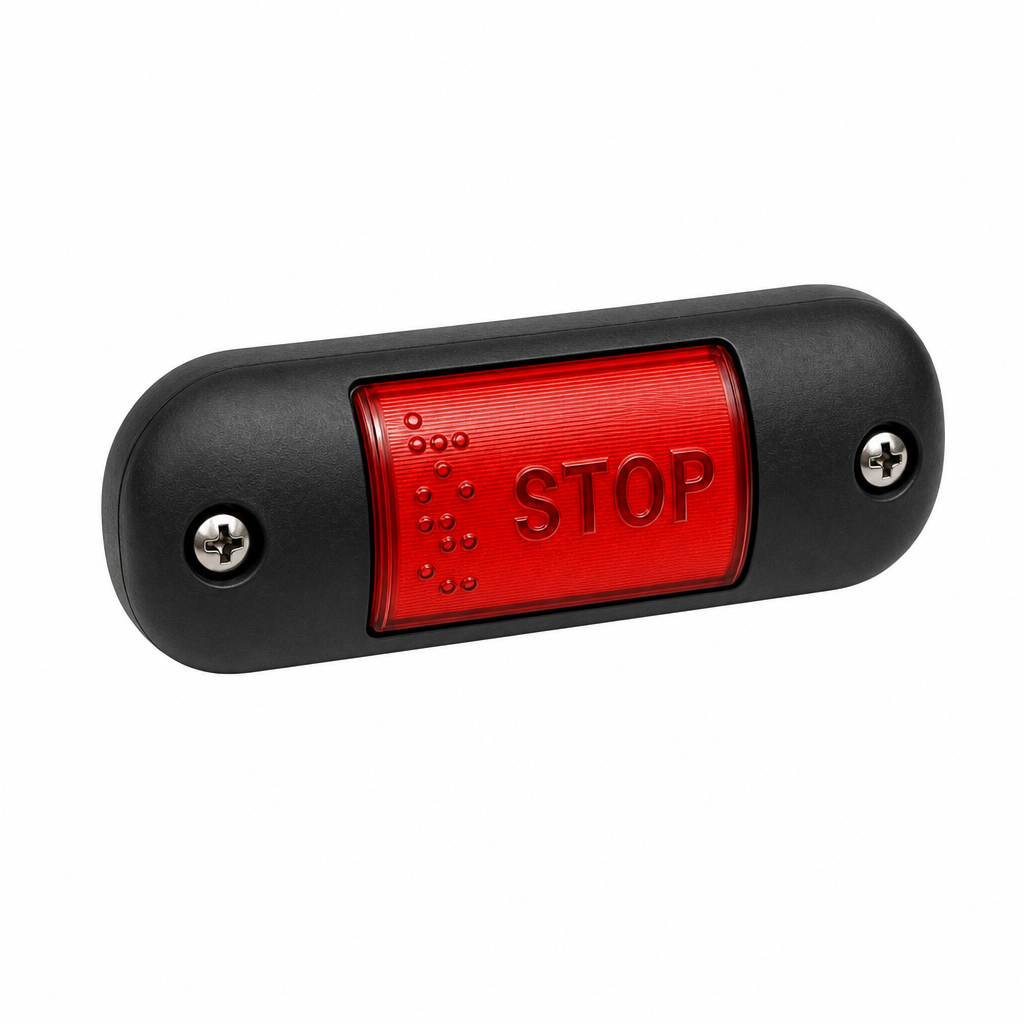
Every public-transport programme needs a passenger stop-request button — the round button on the grab rail or seat-back that a rider presses to tell the driver “I want the next stop”. The JDK-2306 is Youlai’s accessibility-oriented version of that button. Where a plain stop button only closes a contact, the JDK-2306 gives the passenger three confirmation channels the moment they press it: a colour change on the ring indicator, a short tactile vibration, and a raised STOP legend with braille that can be found by touch alone. That combination is what lets the same button serve a sighted rider, a rider with low vision, and a rider who cannot easily see the small overhead “stop requested” sign at the front of the vehicle.
Electrically the button is deliberately simple: a self-return (momentary) contact rated across a wide 9 – 36 V range, so a single part number drops into both 12 V minibuses and 24 V city buses without changing the SKU. The button reports the press; the vehicle’s body-control module or dedicated annunciator is what latches the “stop requested” state, drives the front chime and overhead sign, and clears the request when the doors open. Keeping the latching logic in the module — not in each button — is what lets a coach carry a dozen of these buttons on one loop without any of them fighting over state. This is a routine service request, not an emergency control: for a bus emergency stop that calls the vehicle to a controlled halt, see the separate TDK-2419 bus EDSS emergency-stop unit.
Built for accessibility
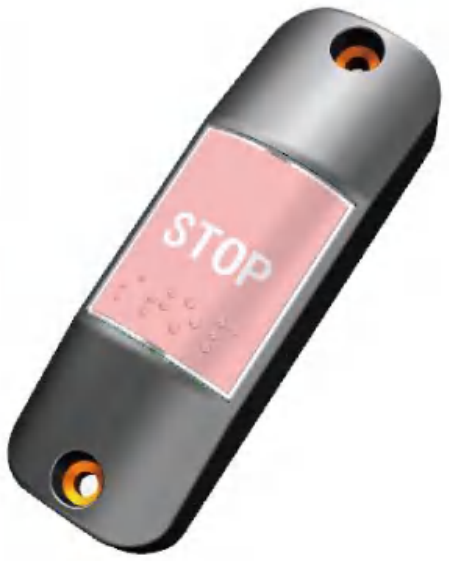
The three feedback channels are the reason this SKU exists rather than a bare contact button. The indicator sits green in standby and switches to red the instant the press is registered, at even brightness across the ring so the change reads clearly from a seated angle in daylight or at night. The vibration pulse gives a rider confirmation without needing to look at or hear anything — important on a moving vehicle where the overhead chime competes with road noise. The braille marking and the raised STOP legend let a rider locate and confirm the correct button by touch. For operators specifying vehicles against local accessible-transport requirements, these are the features that set an accessibility-oriented passenger-request button apart from a generic push-button.
Two mounting formats
The JDK-2306 is supplied for two mounting situations, so the same button covers both the flat surfaces and the round rails of a bus interior. The flush-mount format seats into a flat panel — a seat-back, a door pillar trim or a dedicated request-button plate. The Ø32 / Ø35 pillar mount clamps onto the vertical and horizontal grab rails (stanchions) that run through the saloon, which is where most stop buttons actually live so a standing passenger can reach one. Because orientation matters for a legend that has to read “STOP” the right way up and braille that has to sit under the fingertip, the assembly references call out STOP orientation, braille position and connector position at build — on the horizontal-mount variant the connector exits to the left. Confirm the target rail diameter and mounting face with us when you request a quotation.
Durability & environment
The 200,000-cycle self-return life is sized for the duty of a transit button: a busy city route can see a single door-area button pressed thousands of times a week, and the button has to keep the same feel and the same clean make/break for years of that. The IP5K2 rating (ISO 20653, the automotive IP scheme) means the button is dust-protected and resists dripping water at up to 15° from vertical — the interior-cabin level appropriate for a passenger-facing control, covering condensation, incidental drips and a wiped-down surface. Read it literally when you place the part: dripping water is not a spray rating, and it is nowhere near the direct pressure-wash exposure an exterior chassis switch sees. The full −40 to +85 °C working and storage range covers vehicles that sit out overnight in cold-climate depots as readily as buses working in hot, humid service.
Compliance
Materials are RoHS compliant and the housing carries a UL94-HB flammability rating — relevant for interior-trim bills of materials where the vehicle builder flows hazardous-substance and flammability requirements down to every cabin component. A declaration of conformity is available on request as part of the PPAP package.
Manufacturing & testing
Built under IATF 16949 with APQP project planning and a PPAP package available for OEM programmes. End-of-line testing covers contact make/break per press, indicator colour-change verification, vibration-feedback function check, and operating-force sampling against the 12 ± 4 N window. Cycle-life endurance is verified on a sample basis in our in-house lab when a programme requires fresh validation.
How to ask
The JDK-2306 belongs to the Switches & Sensors family. For an all-cabling wired stop-request system this button reports to the vehicle’s body-control module or annunciator, which latches the request and drives the chime and overhead sign — on 24 V platforms that role can sit on a module such as the EBX-954; where you would rather avoid running a harness down every stanchion, see the wireless stop-request button (TDK-2406 / TDK-2407) instead. If you are still weighing the two, the bus stop request button buyer guide walks through how a press reaches the driver and what to confirm before a quote. To request the wiring schedule, the rail-diameter / mounting options or a fleet-grade batch quotation, use the contact page. These help if you already have them: target vehicle programme, expected annual volume, and key requirements (mounting format, rail diameter, 12 V or 24 V system, braille / legend language). Drawings welcome.