Overview
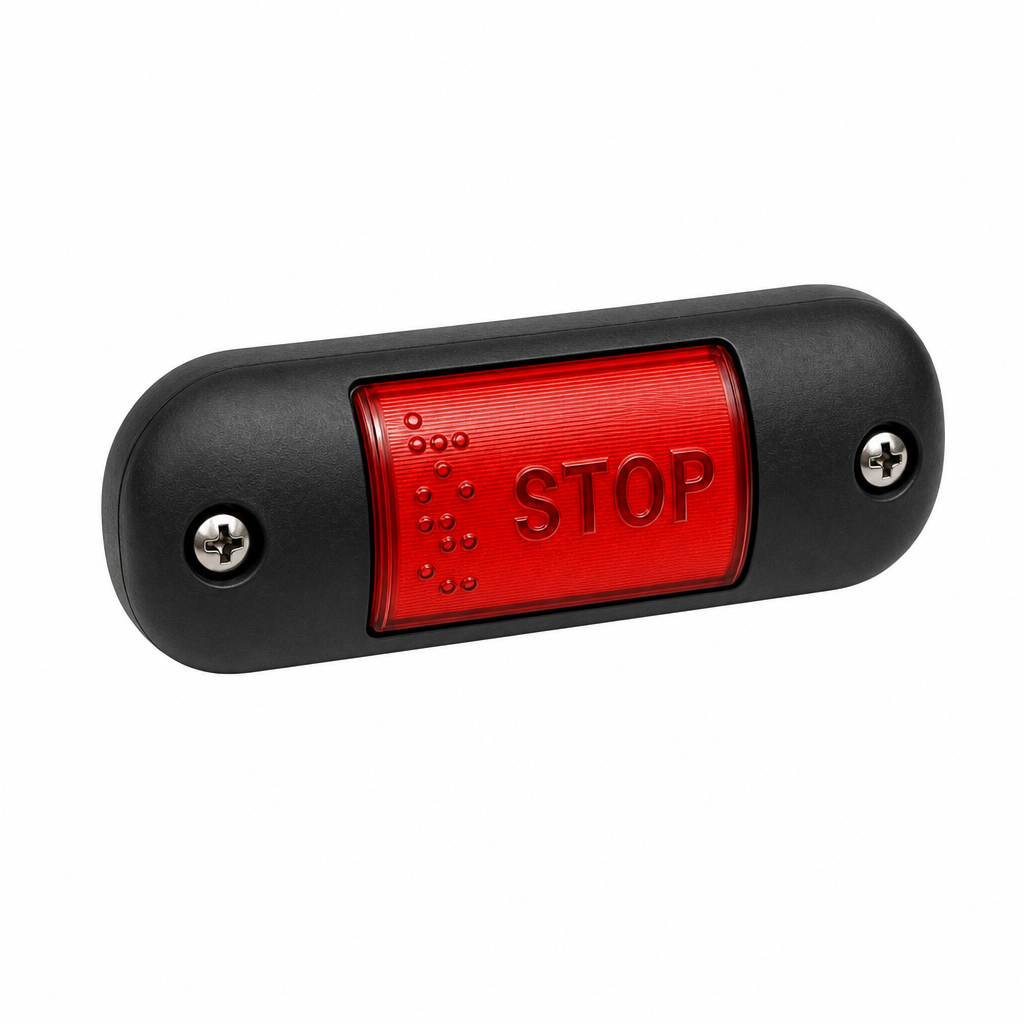
A stop-request button has to sit wherever a passenger can reach it — on stanchions, seat-backs and door pillars scattered through the saloon. Running a wired harness to every one of those positions is the expensive part of the job, and it is close to impossible on a retrofit or a mid-life refurbishment where the trim is already fitted. The TDK-2406 and TDK-2407 solve that by carrying their own battery and sending the press over a short-range 433 MHz radio link instead of a wire: mount the button, learn-pair it to the receiver, and it is live. That is what makes them a practical option for fitting extra request buttons to an existing fleet, or for building a bus where the interior layout is not fixed until late in the programme.
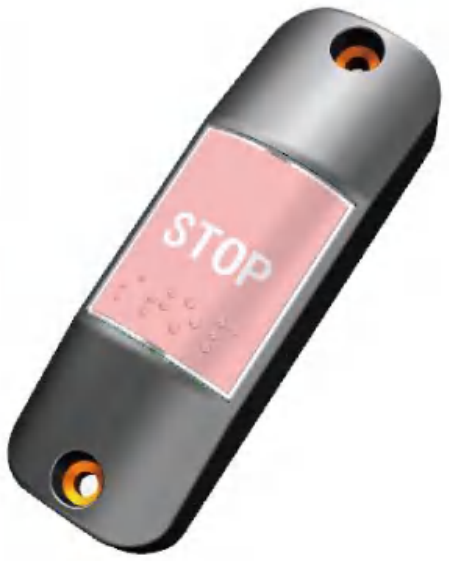
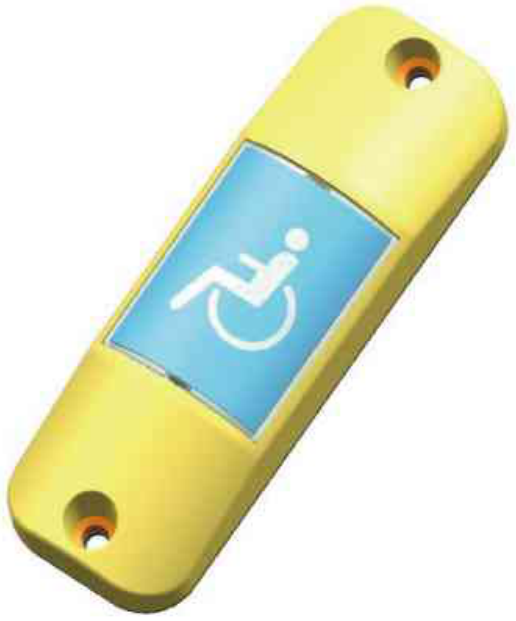
The two part numbers cover the two press types a transit operator has to distinguish. TDK-2406 is the ordinary “stop at the next station” button. TDK-2407 is the accessibility button — the one a wheelchair user or a passenger needing the ramp presses, which the vehicle can be set up to treat differently — for example a longer dwell at the stop or a ramp-deploy prompt to the driver. Both buttons transmit to the same receiver but on separate learned identities, so the system never confuses a ramp request with a routine stop.
How the wireless system works
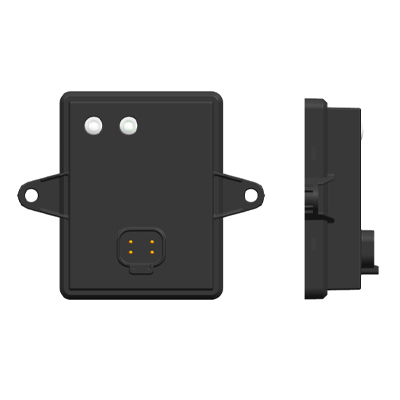
Each button is a self-contained transmitter: press it (a 12 ± 4 N self-return action, the same tactile feel as a wired button), and it emits a short 433.07 MHz burst. The EBX-2404 wireless receiver — mounted on the driver-side bracket where its status LEDs are visible — listens for those bursts and drives two separate low-active outputs: one channel for the general stop-request (TDK-2406) and one for the accessibility request (TDK-2407). A single receiver learn-pairs up to 16 buttons, so a full-length articulated bus can carry a realistic number of request points on one receiver. The receiver also debounces near-simultaneous presses, so a crowded standing load pressing several buttons at once still registers as one stop-request rather than a chain of them.
Because the buttons are battery-powered, the transmit current is kept low — ≤ 18 mA at 3 V per the spec. The battery format and the expected service interval are confirmed per project against your press frequency and duty cycle, so send us your route profile with the enquiry.
Durability & environment
The self-return mechanism is rated to 300,000 operations — higher than the wired JDK-2306’s 200,000 — which gives extra headroom on high-traffic door-area positions that can see thousands of presses a week. The IP5K2 rating (ISO 20653) covers the cabin-interior exposure a passenger-facing button sees, and ESD level 4 / class A immunity protects the radio electronics against the static discharge that is routine when passengers touch a button after walking a carpeted or dry-air saloon. The full −40 to +85 °C working range covers cold-climate depots and hot-service duty alike.
Wireless vs wired — how to choose
The wireless TDK-2406 / TDK-2407 and the wired JDK-2306 solve the same passenger-request job two different ways. Choose wireless when you are retrofitting an existing fleet, when the interior layout is not finalised, or when running a harness to every button position is impractical — you trade a battery-service task for zero cabling. Choose the wired JDK-2306 when the vehicle is designed from scratch with the harness planned in, when you want maintenance-free buttons with no battery to change, or when the button also has to carry the vibration / braille accessibility feedback that the wired part provides at the button itself. Many programmes mix both: wired buttons on the primary door pillars, wireless buttons to fill in the awkward positions.
Compliance
Materials are RoHS compliant and the housing carries a UL94-HB flammability rating. As a radio-transmitting product, the applicable radio type approval for the destination market is confirmed per project on a programme basis. A declaration of conformity is available on request as part of the PPAP package.
Manufacturing & testing
Built under IATF 16949 with APQP project planning and a PPAP package available for OEM programmes. End-of-line testing covers transmit-burst verification against the 433.07 MHz band, pairing handshake with a reference receiver, operating-force sampling against the 12 ± 4 N window, and current draw at 3 V. Range and cycle-life endurance are verified on a sample basis in our in-house lab when a programme requires fresh validation.
How to ask
The TDK-2406 / TDK-2407 belong to the Switches & Sensors family and are normally quoted together with the EBX-2404 receiver. For how the wireless and wired approaches compare and how a press reaches the driver, see the bus stop request button buyer guide. A stop-request button is a service control; for an emergency stop that brings the bus to a controlled halt, that is a separate safety function — the TDK-2419 bus EDSS emergency-stop unit. To request the pairing procedure, the battery / service-interval guidance or a fleet-grade batch quotation, please use the contact page with your target vehicle programme, expected annual volume, and key requirements (number of general vs accessibility buttons, destination market for radio approval, mounting positions). Drawings welcome.