Overview
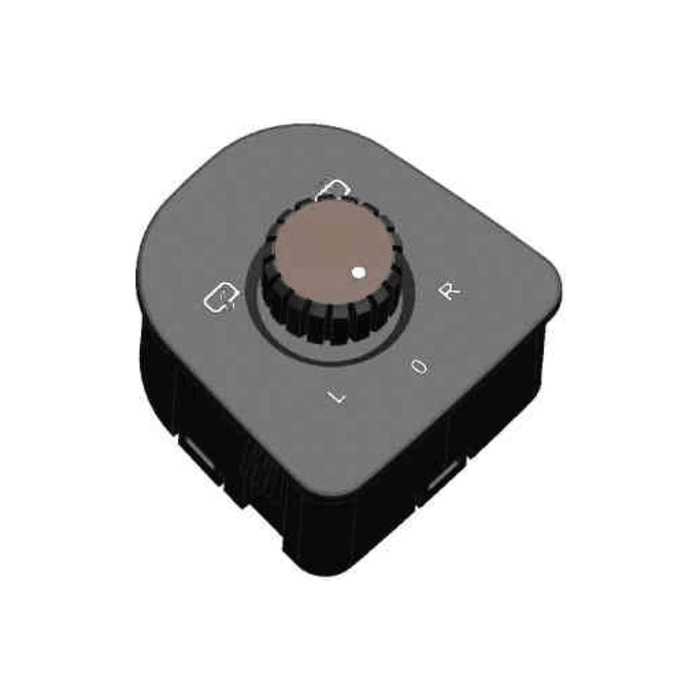
Every vehicle with powered exterior mirrors needs a driver-side control to aim them, and the TDK-2307 is the rotary version of that control. Instead of a cluster of separate keys, it uses one knurled knob: the driver turns it to select which mirror is live — the L or R position marked on the face — and then works the knob to drive the mirror motors so the glass tilts up, down and across. The module reports those commands to the mirror actuators through the cab harness; it does not carry the mirror motors itself.
Electrically it is a plain, robustly specified cabin switch: a 24 V rating with an 18 – 32 V working window, a voltage drop held to ≤ 200 mV so the signal stays clean over a long door-to-mirror run, and insulation that withstands a 550 V / 50 Hz impulse without breakdown. Because it is a rotary rather than a multi-key panel, it takes up little dash or door-panel real estate, which is why it suits cabs where the mirror control has to share a crowded switch bank.
One knob, two mirrors
The rotary format is the reason a programme picks this module over a four-way rocker. Selection and adjustment run through the same knob, so the footprint is a single round cut-out rather than a rectangular multi-key plate. The face carries the two mirror-select markings (L and R) and a mirror symbol to GB 4094, so the legend reads correctly to a driver who has never seen the specific part before. For cab programmes that already run a rotary HMI language on the dash — rotary light or climate controls — a rotary mirror module keeps the interface consistent.
Durability & environment
The 50,000-operation rating is sized for a control that a driver touches at the start of most shifts and then leaves alone — far lower duty than a stop button or an indicator stalk, but still qualified so the knob keeps its detent feel and clean contact for years. The −40 to +80 °C working range covers cabs that cold-soak overnight in winter depots and those working through hot, humid summer service. As a cabin-interior control it is specified for the protected door-panel environment rather than direct water exposure; confirm the mounting cut-out and connector orientation with us at quotation.
Compliance
The switch is built to the QC/T 198 general automotive-switch specification, with symbol markings to GB 4094. Programme-specific approvals — material declarations, and any customer or destination-market requirements — are confirmed on a project basis; a declaration of conformity is available on request as part of the PPAP package.
Manufacturing & testing
Built under IATF 16949 with APQP project planning and a PPAP package available for OEM programmes. End-of-line testing covers contact make/break on each detent position, voltage-drop sampling against the ≤ 200 mV limit, and connector retention. Endurance to the 50,000-operation window is verified on a sample basis in our in-house lab when a programme requires fresh validation.
How to ask
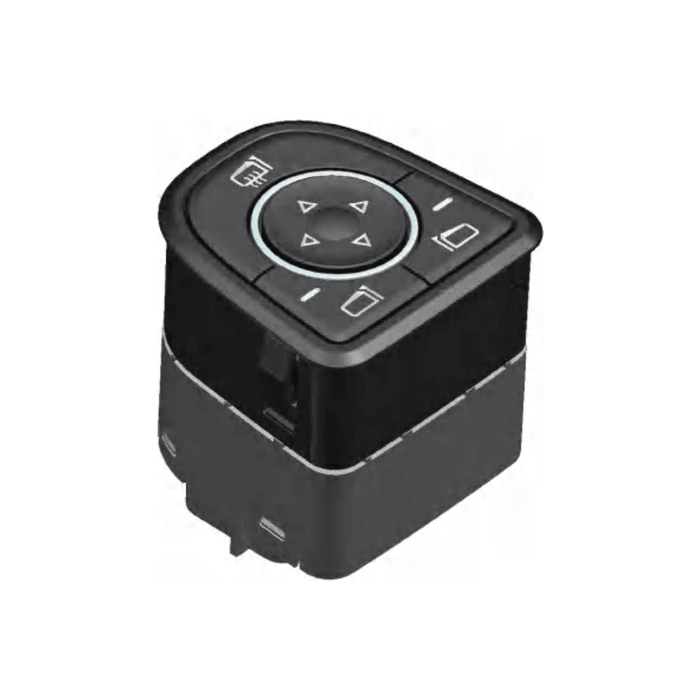
The TDK-2307 belongs to the Switches & Sensors family. If your programme would rather use a multi-key rocker with a four-way direction pad and a dedicated mirror-heat key, see the EDK-2319 powered side-mirror switch instead; the commercial vehicle mirror systems buyer guide walks through how powered mirror control works and where camera monitor systems (electronic mirrors) are heading. To request the connector pinout, the mounting cut-out or a fleet-grade batch quotation, use the contact page. These help if you already have them: target vehicle programme, expected annual volume, and key requirements (12 V or 24 V system, mirror-motor type, connector preference). Drawings welcome.