Overview & positioning vs YDK-902
The YDK-903 is the second TPMS sensor in the Youlai heavy-truck family, complementary rather than alternative to the YDK-902 valve-stem sensor. The two variants share the same 433.92 MHz frequency-hopping RF link, the same pressure / acceleration / temperature sensing payload, the same target 5–8 year battery life and the same receiver pairing flow — so a fleet operator running a mixed wheel population can specify both variants under a single TPMS protocol and a single in-cab receiver type.
The mechanical difference is the only thing that changes between the two:
- YDK-902 — valve-stem mount. The sensor sits on the valve stem, M5 stainless retaining screw, no external antenna. Standard route for trucks, buses, trailers and multi-axle commercial vehicles where the rim takes a conventional metal valve.
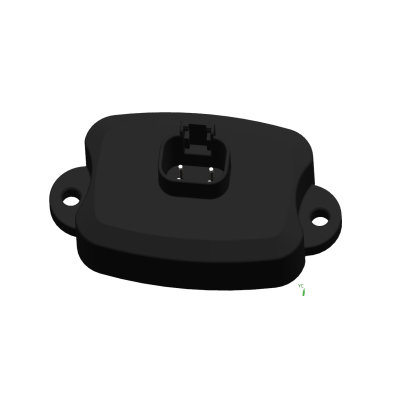
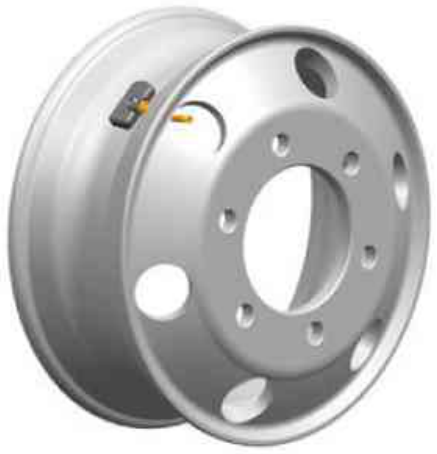
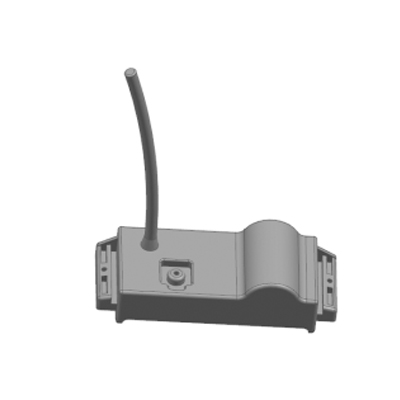
- YDK-903 — clamp-mount with whip antenna. The sensor body clamps to a chosen point inside the rim or wheel cavity, with an external whip antenna routed into the cavity. Used on programmes where the rim does not accept a valve-stem TPMS — heavy-duty mining wheels with non-standard valve geometry, special trailer rims, drop-centre wheels with cooling fins that interfere with the YDK-902 body, and other custom-wheel programmes.
Both variants speak the same protocol to the same in-cab receiver — typically the Youlai EBX-957 TPMS receiver, or an OEM-equivalent. The wheel-by-wheel ID coding is what tells the receiver which axle / which position is reporting.
What it senses
- Pressure. Tyre cavity pressure, the primary TPMS signal — reported continuously while the wheel is rotating, with low-rate watchdog reports while parked.
- Acceleration. Used as a wake-up trigger and as a "wheel rotating" qualifier, so the sensor stays in deep sleep when the truck is parked and saves battery.
- Temperature. Tyre cavity temperature — used in the receiver's pressure-correction algorithm and to flag overheating brakes / under-inflated tyres on long descents.
Mechanical & mounting
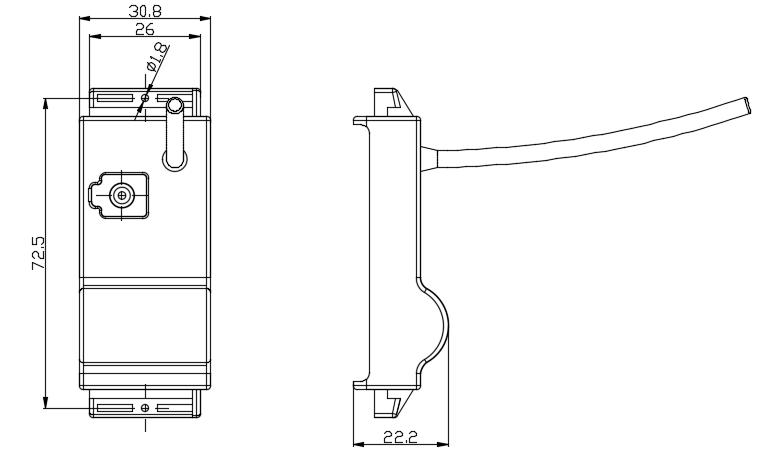
The YDK-903 footprint is 30.8 × 72.5 mm with a body depth of around 22.2 mm, mounted via an integrated clamp body to a Ø1.8 mm pilot point. The external whip antenna routes out of the body so the RF link works from inside the wheel cavity even when the sensor itself is shadowed by the rim metal — this is the engineering reason for the external antenna versus YDK-902's body-integrated antenna.
Battery life & housing
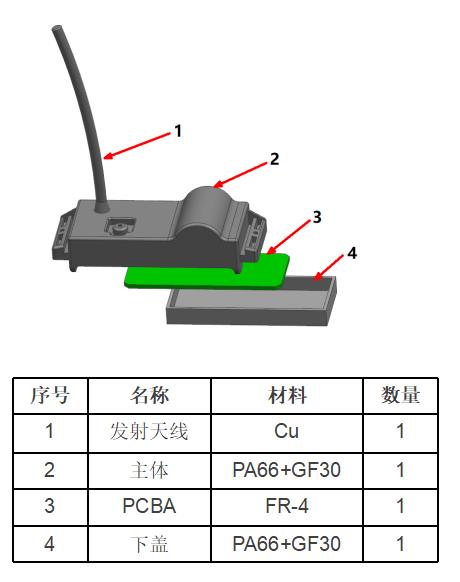
Same as the YDK-902 baseline: a sealed IP66 housing in PA66-GF30 (30% glass-filled polyamide) over an FR-4 PCBA. Battery life is 5–8 years.
RF link & receiver pairing
The 433.92 MHz link is frequency-hopping with ±0.5 MHz spread, and transmits at −10 dBm — identical to YDK-902. Pair the YDK-903 with the Youlai EBX-957 TPMS receiver for a complete wheel-to-cab system, or specify your OEM-preferred receiver at quotation. RF protocol details and ID-coding are confirmed against your fleet plan. A fleet that mixes YDK-902 and YDK-903 wheel positions runs against the same receiver and the same in-cab display without any protocol-level configuration change.
Manufacturing & testing
Built under IATF 16949 with APQP project planning and a PPAP package available for OEM programmes. Every sensor goes through end-of-line pressure, RF transmit and battery-current checks before packaging. Cold-chamber and high-altitude validation is run on a sample basis in our in-house lab when the programme requires it.
How to ask
The YDK-903 belongs to the Switches & Sensors family. For the wheel-count, pressure-threshold and receiver-interface checklist that goes into a fleet specification, see the heavy-truck TPMS buyer guide. To request the sensor-to-receiver pairing protocol, the wheel-installation drawing for your specific rim geometry, or a fleet-grade configuration that mixes YDK-902 and YDK-903 positions, use the contact page. These help if you already have them: target vehicle programme, expected annual volume and key technical requirements (number of axles, rim type per axle, OEM receiver if any, pressure range). Drawings welcome.