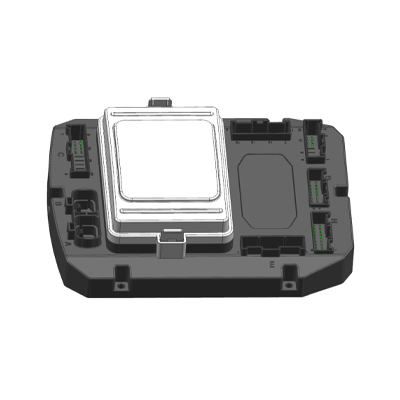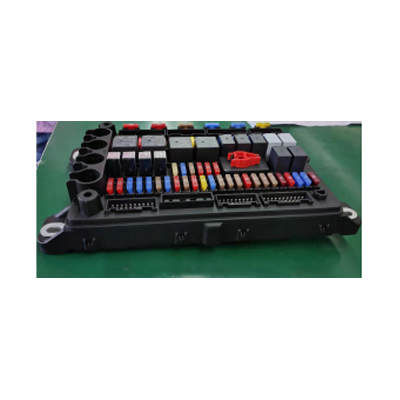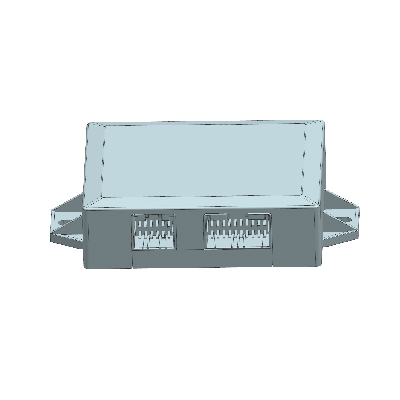
Overview — higher-current sibling to the EBX-2050
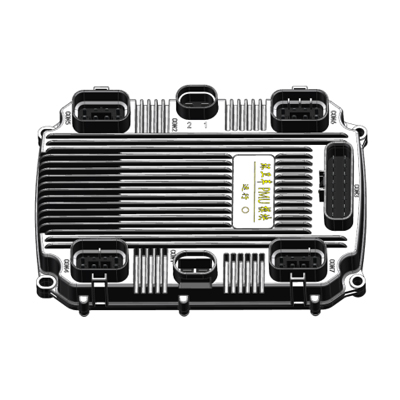
The EBX-2052 is the EBX family's higher-current PMU. Where the EBX-2050 sits in a sealed plastic housing with an integrated 12-fuse + 4-relay distribution sub-section optimised for hydraulic-rich solenoid scope, the EBX-2052 trades the integrated PDB-side for raw current capability: a finned aluminium housing for direct convective heat-shedding, the IP66 sealing class that lets the controller sit chassis-side directly exposed to road-spray, 16 PWM-capable channels split across the 15 A and 9 A drive classes, and two dedicated 50 A direct DO channels for the largest accessory loads that would otherwise need an external relay.
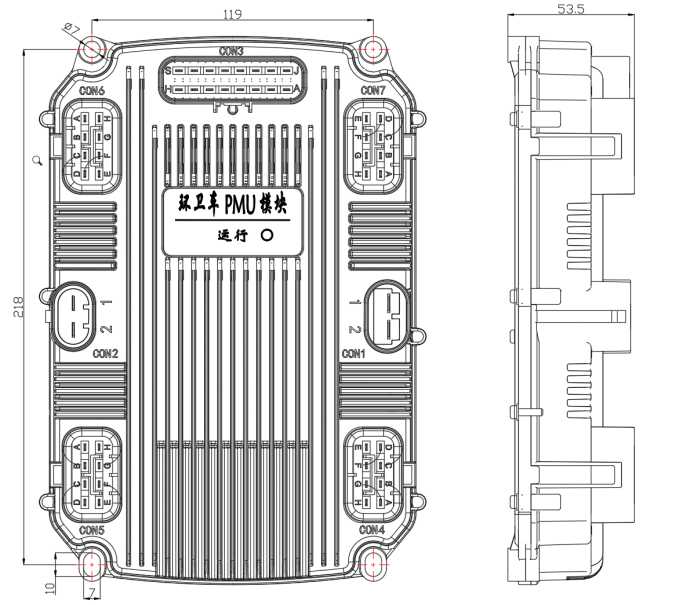
The 7-connector harness face is split into a 3-connector signal side (3 Delphi connectors — CON1 / CON2 on the side and CON3 across the top edge) and a 4-connector heavy-current actuator side (4 Bussmann connectors on the four corners). The split keeps the heavy-current side physically separated from the signal side — important for signal integrity when the heavy-current side is switching high-PWM-duty inductive loads. The dual-CAN front-end is the second major architectural difference from the EBX-2050: the EBX-2052 can sit between two vehicle network segments (one CAN to the body BCM side, one CAN to the powertrain / chassis side), which is what makes selective forwarding between them possible where a programme needs network segregation — scoped as firmware work against the network design rather than supplied as a fixed routing table. Even in that position, the EBX-2052 stays a power-distribution unit — it carries the current and protects it, while a BCM owns the body-logic decisions and a VCU owns the powertrain strategy; the BCM vs VCU vs PMU comparison sets the three apart.
I/O capability set
16 × PWM-capable HSD channels (15 A and 9 A drive class)
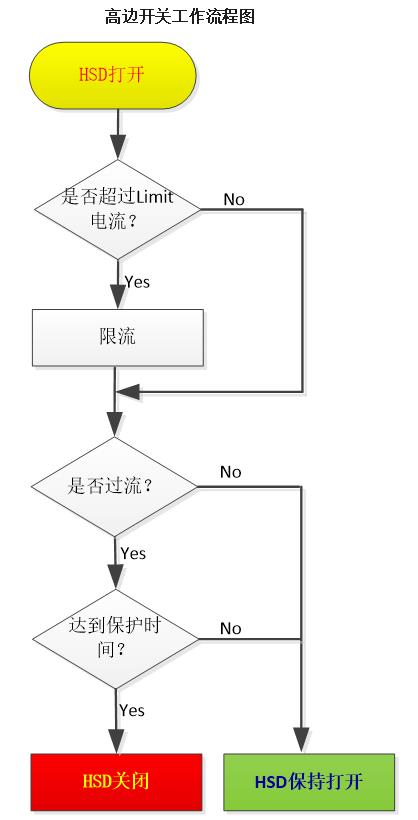
The 16 PWM-capable high-side-driver channels are split into a 15 A drive class and a 9 A drive class on a per-channel basis. The 15 A class is allocated to the larger inductive solenoid loads (e.g. main hydraulic-valve solenoids, large blower-fan relays, headlight relays); the 9 A class is allocated to the smaller solenoid loads (e.g. secondary valves, accessory-light relays, indicator-bank drives). Each channel runs the smart HSD protection envelope — current-limit + over-current + protect-time trip + auto-re-enable.
2 × 50 A high-current direct DO channels
The 2 dedicated 50 A DO channels are the headline feature. These are direct high-current output channels (not PWM-modulated), built on a heavier-duty drive stage with dedicated thermal management at the silicon-side and an oversized Bussmann harness termination on the connector side. They are intended for the largest accessory loads on the vehicle — the work-light bank on a heavy-construction truck, the hydraulic pump motor on a hydraulic-rich programme, the blower motor on a heated-cab application, the secondary heater element on a winter-package programme. Loads that, on a different ECU, would force the program to add an external relay are driven directly here.
15 × digital inputs + 5 standard DO channels
The 15 digital inputs absorb the program's switch / sensor inventory. The 5 standard DO channels (counting outside the 2 × 50 A channels) are typical lower-current accessory drives.
Engineering details
- Finned aluminium housing — direct convective cooling for sustained heavy-current operation; the finned top face is the primary heat-shed surface and should be installed with the fin axis aligned for natural convection (vertical fins for chassis-side mounting)
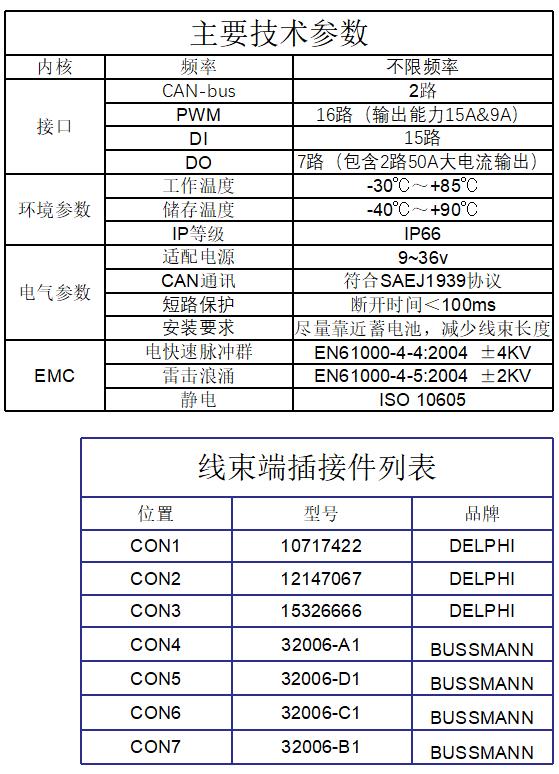
- IP66 protection grade (IEC 60529) — dust-tight and protected against powerful water jets from a 12.5 mm nozzle, which suits chassis-side mounting directly exposed to road-spray and routine jet-wash cleaning; standing water and hot high-pressure lance cleaning are separate tests and belong in the specification in their own right
- 2 × 50 A direct DO channels on dedicated heavier-duty drive stages with Bussmann high-current terminations — eliminates the need for external relays on the largest accessory loads, halves the parts count and the failure surface for the largest-current branch of the harness
- Dual SAE J1939 CAN — two segments on one module, so the unit can be present on both a body-CAN segment and a powertrain-CAN segment at once. That is the hardware precondition for selective forwarding between them; the forwarding behaviour itself is firmware scope confirmed per programme rather than a published routing table, and the J1939 gateway guide sets out what a routing requirement has to state
- Smart per-channel HSD protection envelope — current-limit + over-current + protect-time trip + auto-re-enable + per-channel diagnostic flag (same envelope as the EBX-2050, scaled to the higher per-channel current class)
- EN 61000-4-4 ±4 kV EFT + EN 61000-4-5 ±2 kV surge + ISO 10605 ESD EMC scope at the heavy-truck / construction-machinery hardness level
- Seven-position connector face — 3 Delphi signal connectors + 4 Bussmann heavy-current connectors; signal-side physical separation from heavy-current side
- Run-state status LED on the front face — in-cab visibility of the controller's run state without needing a diagnostic tool
- Install close to the battery per the harness guidance — minimises the heavy-current harness length on the battery-input side, reducing voltage drop and EMC pickup
Mechanical layout
HSD channel smart-protection envelope
Technical reference (regulations / connector P/Ns)
Comparison with the related Youlai PMU modules
| Model | Drive class | PMU side | PDB side | IP grade | CAN count |
|---|---|---|---|---|---|
| EBX-2050 | Standard HSD | 12 PWM + 17 DI + 24 DOH | Integrated 12 fuses + 4 relays | IP54 | 1 × J1939 |
| EBX-2052 | 15A & 9A HSD + 2 × 50A direct DO | 16 PWM + 15 DI + 7 DO | External (program-side) | IP66 | 2 × J1939 |
| EBX-2160 | Relay-based (60+ fuses + 11 relays) | CAN-side network drive only | Integrated CPD-scale | IP53 | 1 × CAN |
The EBX-2052 is the right choice when a programme needs direct 50 A drive capability without external relays and IP66 chassis-side placement directly exposed to road-spray. For a programme that wants the integrated 12-fuse + 4-relay PDB on the same housing (and accepts the IP54 sealing class), look at EBX-2050; for a much larger central power-distribution ECU with 60+ fuses and 11 relays, look at EBX-2160 CPD. The higher-current PMU role this hardware is built for is covered in the power management unit guide.
Manufacturing & testing
Built under IATF 16949 with APQP project planning and a PPAP package available for OEM programmes. Every unit is end-of-line functional-tested before packaging — the 16 PWM channels (each across full-on, full-off and a typical PWM duty + waveform integrity at the channel's drive class), the 2 × 50 A direct DO channels (loaded at the rated current with thermal-rise measurement), the 5 standard DO channels, the 15 digital inputs across the full input range, the smart-HSD protection envelope (Limit-trip + over-current trip + protect-time trip + auto-re-enable cycle on each channel), and the dual SAE J1939 CAN bus health (with a J1939-compliant tool exercising the standard PG sequence on each bus) are all checked. EMC pre-compliance screening per EN 61000-4-4 / -4-5 / ISO 10605 is run in our in-house lab.
How to ask
The EBX-2052 belongs to the Smart Control Modules family. To request the harness drawing, the per-PWM-channel current-class allocation, the 50 A DO channel thermal-derating curve, the dual-CAN routing policy, the J1939 message catalogue or a PPAP package, use the contact page. These help if you already have them: target vehicle programme, expected annual volume and key technical requirements (number of solenoid valves + per-valve current / dwell profile, high-current accessory load list and rated current, dual-CAN segmentation map, EMC profile, IP rating, connector preference). Drawings welcome.