Overview
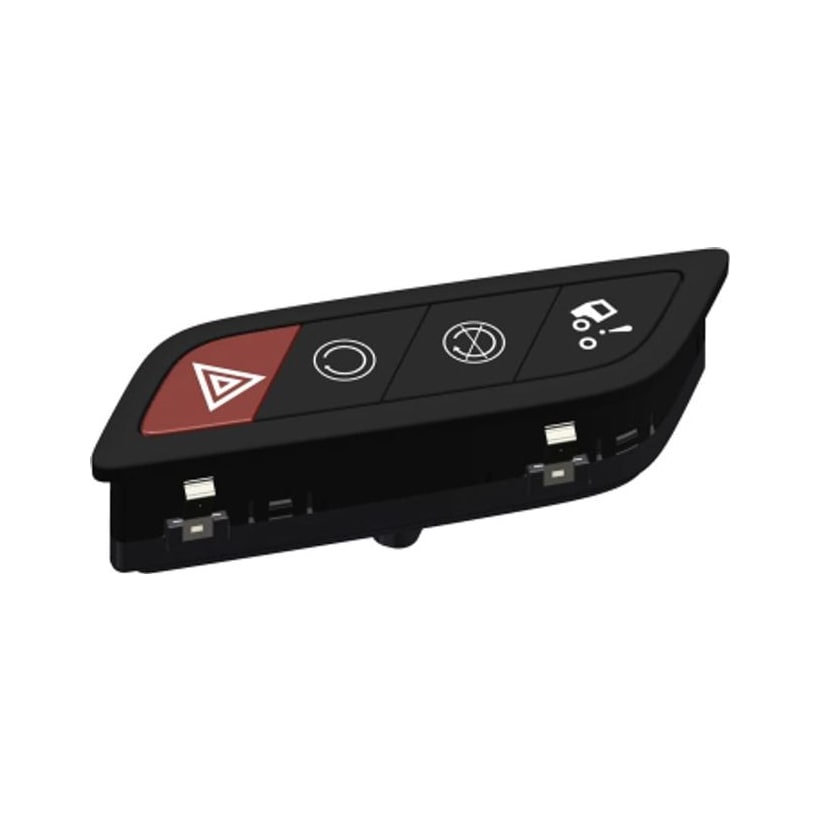
The EDK-2010 is the switch panel that sits on a heavy-truck cab door or side trim and carries the controls used around the cab: tilting the cab for engine access, starting and stopping the engine from beside the vehicle at ground level during service, and the hazard flashers. Rather than four separate switches, they are grouped into one moulded, IP67-sealed panel that measures 140.6 × 40.6 × 49.8 mm and works across a 9–36 VDC (12 V or 24 V) system.
Each function is brought out as two outputs (output 1 / output 2) on a single Molex 2042200008 connector. The panel is an input device: each control reports to the truck’s own systems, which run the cab-tilt pump, the engine start / stop and the hazard circuit — the contact form, current rating and how the two outputs per function are used are confirmed at RFQ. A blue backlight is specified in the standard build and is customisable to match the cab.
The four functions
The panel groups four heavy-truck door-side functions, each brought out as its own pair of outputs:
- Cab-tilt. The control for the hydraulic cab-tilt system that raises the cab for engine and service access.
- Ground-level engine start. A start request made from outside the cab, so a technician can crank the engine while working at ground level.
- Ground-level engine stop. The matching stop request from the same position.
- Hazard flashers. The hazard-warning switch, marked with the standard red triangle.
The ground-level start and stop pair is a maintenance-side control: it lets the engine be turned over and shut down from beside the truck during service, separate from the driver’s in-cab start button. The start authorisation, cab-tilt interlocks and hazard timing stay in the truck’s own systems — confirm the interlocks and safety logic for your programme at quotation. Which icon is printed on which key is set per programme; the electrical function of each terminal is defined by the connector below.
Connector & pinout
The EDK-2010 mates with a Molex 2042200008 connector. The eight ways carry two outputs for each of the four functions (output 1 / output 2). The published port definition is:
| Pin | Function |
|---|---|
| 1 | Cab-tilt switch output 1 |
| 2 | Cab-tilt switch output 2 |
| 3 | Ground-level start switch output 1 |
| 4 | Ground-level start switch output 2 |
| 5 | Ground-level stop switch output 1 |
| 6 | Ground-level stop switch output 2 |
| 7 | Hazard switch output 1 |
| 8 | Hazard switch output 2 |
The published table lists the eight functional lines; the contact form (dry-contact pair or switched output), the current rating, the common / return and backlight supply, and whether any line switches a load directly are confirmed against your harness and control logic at RFQ.
Sealing, feel & durability
The EDK-2010 is rated IP67 (dust-tight and protected against temporary immersion), so it suits an exposed cab-door position that sees weather and dust rather than a dry dash-centre location; because IP67 covers immersion rather than high-pressure jetting, confirm wash-down duty separately if the panel sees a pressure washer. Each button is held to a 450 ± 150 gf press and the mechanism is rated to > 200,000 operations — a high cycle count for a door-mounted control. It works across −30 to +85 °C with −40 to +90 °C storage, and the buttons carry a blue backlight that can be changed to match the cab’s illumination.
Choosing the EDK-2010
The EDK-2010 fits when the job is a door-side function group on a commercial truck — cab-tilt plus a ground-level start / stop for service, with the hazard key on the same panel. It is a hard-wired switch panel, not a networked one, and it is distinct from the driver’s own start control:
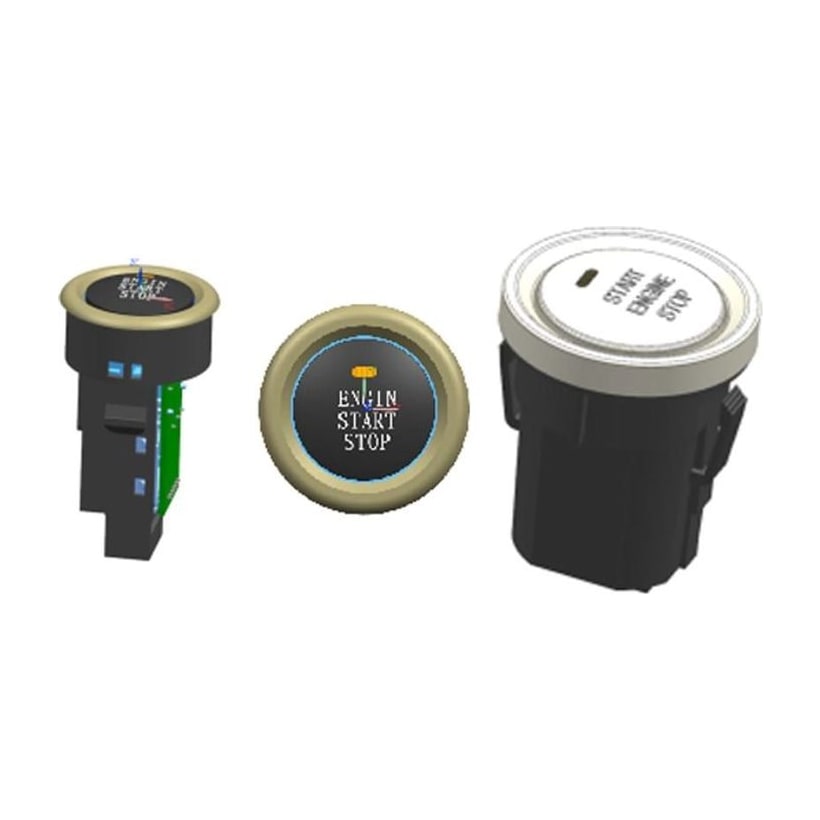
- In-cab engine start. Where the driver starts the vehicle from the seat, the TDK-902 / TDK-905 engine start-stop push button is the in-cab control; the EDK-2010’s ground-level start / stop is the service-side counterpart used from outside the cab.
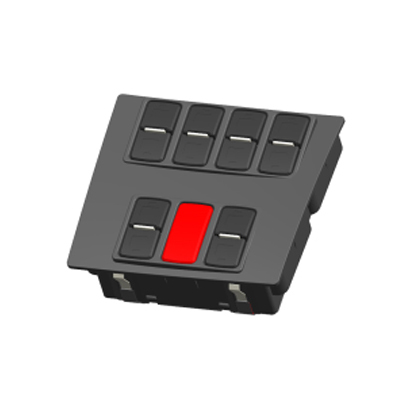
- A networked multi-function panel. Where the cab needs many labelled functions on the bus rather than four hard-wired ones, the EDK-907 CAN rocker switch panel puts each function on CAN with a hard-wire backup on the safety-critical key.
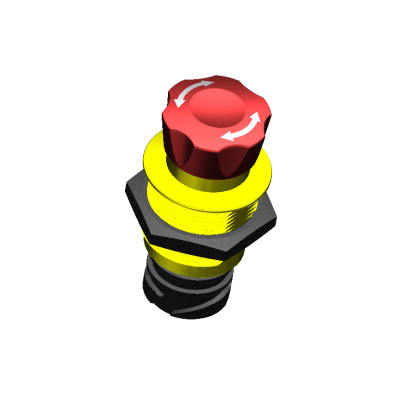
- A dedicated emergency stop. Where the requirement is a single latching safety cut-off, the JDK-2425 emergency-stop switch is the separate control for that function.
- A hazard switch on the dashboard. Hazard is one of four keys here, on the door. Where the vehicle needs the hazard function in its own dashboard position with its own lit triangle, that is the TDK-901 hazard warning switch — the two are often specified on the same truck.
For the wider trade-off between hard-wired switch panels and CAN switching, see the CAN bus switch panel guide, or browse the full Switches & Sensors range.
Manufacturing & testing
Built under IATF 16949 with APQP project planning and a PPAP package available for OEM programmes. End-of-line testing follows the programme’s control plan — typically switch-output continuity, illumination and actuation force — while endurance, IP67 sealing and temperature soak are validated on a sample basis in our in-house lab when a programme calls for fresh qualification.
Common questions from buyers
What are the four buttons? Cab-tilt, ground-level engine start, ground-level engine stop and hazard flashers. Each function is brought out as two outputs on the 8-way Molex 2042200008 connector, shown in the pinout above.
Does the panel start the engine or run the cab-tilt motor directly? It is a switch panel: each control switches its terminals, and the truck’s own systems run the cab-tilt hydraulics, engine start / stop and hazard circuit with their own interlocks. Contact ratings and whether any line switches a load directly are confirmed per programme.
What are the eight pins? Two outputs for each of the four functions (output 1 / output 2), listed in the pinout above. The contact form and how each pair is read are confirmed against your control logic per programme.
What is the difference between this and the TDK-902 / 905 start button? The TDK-902 / 905 is the driver’s in-cab engine start-stop button. The EDK-2010’s start / stop pair is a ground-level service control on a door panel, alongside cab-tilt and hazard. They are complementary, not interchangeable.
Is it sealed for an exterior door position? Yes — it is rated IP67 (dust-tight, protected against temporary immersion), suited to a cab-door location exposed to weather and dust; confirm high-pressure wash-down separately.
How to ask
The EDK-2010 belongs to the Switches & Sensors family. Tell us the target truck programme, the system voltage, the button legends and icon set you need, and how the cab-tilt, start / stop and hazard circuits are wired — and we will confirm the connector pinout, the contact form and the backlight colour. Use the contact page; drawings welcome.