Overview
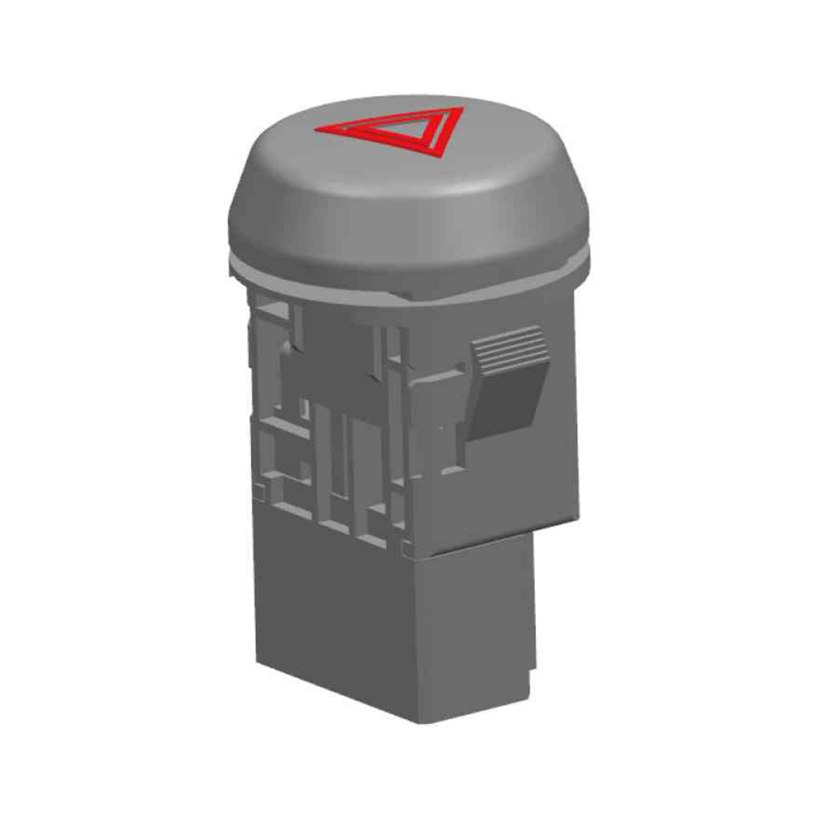
Every vehicle needs one switch that anybody can find without looking for it, and on a dashboard that switch is the hazard button. The TDK-901 is Youlai’s panel-mount version: a tall plunger body that drops through a 27 × 20 mm cut-out, capped by a 32.5 × 23.4 mm face carrying the red hazard triangle, with the triangle itself lit in red. It is a 24 V part (18–32 VDC), holds −30 to +85 °C in service and −40 to +90 °C in storage, and is rated IP52 — the level appropriate to a dashboard position rather than an exposed or wash-down one.
Youlai lists the TDK-901 for commercial vehicles, new-energy vehicles and passenger cars, which is what you would expect from a part whose function is the same on every vehicle. What varies between programmes is the circuit it sits in and the harness it plugs onto, and those are the two things fixed on the release drawing rather than in the catalogue.
No PCB inside
The single most useful thing on the TDK-901 datasheet is a negative: copper-blade sliding contacts, no PCB. The moving part of the switch is a PA66-GF15 slider that carries copper blades across fixed contacts; there is no printed circuit board, no surface-mount component and no solder joint inside the switch body. A dashboard part spends its life on a structure that vibrates continuously across a 115 °C rated service band (−30 to +85 °C), and solder joints and board cracks are a normal failure mode in that environment. Removing the board removes that mode.
The rest of the build follows the same logic. The button is PC, the body and bottom cover are ABS+PC, the retaining block is POM, and the return spring is steel wire — a six-part moulded and formed assembly. Apart from the contact set and the lamp behind the triangle there is nothing electrical inside it — no board, no solder joints, no bus interface to validate. It is the reason a mechanically simple hazard switch is still specified on vehicles whose dashboards are otherwise full of bus-connected panels.
Feel and travel
A hazard button is pressed under stress, often by a driver who is not looking at it, so the tactile specification matters more than it does on an ordinary cab switch. The TDK-901 is set at 5 ± 1.5 N — firm enough that it is not triggered by a sleeve, light enough to press with the side of a hand. Total travel is 5.5 mm and the contacts make at 3.5 mm, which leaves 2 mm of overtravel past the switching point: the circuit closes before the button bottoms out, so a firm press cannot land in the gap between “moved” and “switched”. Endurance is rated at more than 50,000 operations.
The published data covers travel, force, endurance and life; it does not fix the contact arrangement, the contact action or the current the contacts may carry. Those are set against your circuit — whether the switch feeds a flasher unit directly or reports to a body controller changes all three — and are confirmed on the release drawing at RFQ.
Panel fit and mounting
The TDK-901 is a through-panel plunger, so the fit is defined by three numbers. The cut-out is 27 × 20 mm, toleranced +0.1 / −0 on the 20 mm dimension. The body that passes through it is 26.8 × 20 mm, and the cap that covers it is 32.5 × 23.4 mm, so the face overlaps the aperture on every side. Behind the panel the switch needs 82.7 mm of length in total, including the connector shroud — worth checking early against the depth available behind a centre stack, because it is the dimension most often discovered late.
Terminals and mating harness
The switch terminates in an integral connector shroud whose harness side is a DJ7081-2.3-21, an 8-way housing with the cavities in two rows — five in the upper row, three in the lower. It is the same 8-way boot family used on the single-window switch of the TDK-2202 power-window set, which is useful if you are consolidating connector part numbers across a cab harness.
| Item | Detail |
|---|---|
| Mating connector | DJ7081-2.3-21 |
| Ways | 8 (5 upper row · 3 lower row) |
| Circuit assignment | Confirmed per programme on the release drawing |
| Contact rating | Confirmed per programme against your circuit |
Eight ways is more than a plain on/off contact needs, which is what you would expect on a part that has to carry both a switching set and the feed for the illumination. The cavity assignment itself is not a catalogue figure — it follows the contact arrangement your programme needs. Tell us how the hazard function is wired on your vehicle, direct to a flasher unit or as an input to a body controller, and we confirm the cavity map and the rating with the drawing.
Sealing and environment
The TDK-901 is rated IP52: dust-protected, and protected against water dripping at up to 15° from vertical. That is a cab-interior rating, matched to a dashboard face where the exposure is dust, condensation and incidental drips. Read it literally when you place the part — dripping at 15° is not the same thing as a drink emptied over the console, and it is nowhere near a wash-down rating. It holds −30 to +85 °C in service and tolerates −40 to +90 °C in storage and transport. For an exposed panel or an exterior-mounted control, choose a sealed part such as the JDK-2201 at IP67. If the position is washed down rather than submerged, name that duty separately — jets and immersion are different tests, and the right answer there may be a jets rating rather than IP67.
How it compares with other Youlai cab switches
Several Youlai parts put a button on a dashboard, but they answer different jobs:
| Specification | TDK-901 (hazard) | JDK-901 (rocker) | TDK-2513 (round button) |
|---|---|---|---|
| Form | Through-panel plunger, hazard triangle cap | Rocker paddle with hinged protective cover | Illuminated round self-reset button |
| Operating voltage | 18–32 VDC | 18–32 VDC | 24 V system |
| Protection grade | IP52 | IP53 | IP5K2 |
| Internals | Copper-blade sliding contacts, no PCB | 8 copper blade terminals | Illuminated button assembly |
| Endurance | > 50,000 operations | > 50,000 operations | > 1,000,000 operations |
| Best for | The one switch that must be found without looking | A tidy row of matching cab-function rockers | A lit momentary input in a button cluster |
Choose the TDK-901 when you need a dedicated hazard control with its own dashboard position and its own symbol. If the hazard function instead belongs on a multi-function door panel — alongside cab-tilt and ground-level start-stop — see the EDK-2010 cab door-panel switch, which carries hazard as one of four functions at IP67. If the whole dashboard is moving to a bus-connected panel, the CAN vs LIN vs hard-wired comparison sets out where a discrete switch like this one still wins.
Where it fits
The TDK-901 belongs to the Switches & Sensors family of cab panel hardware. It sits alongside the other discrete dashboard controls — TDK-902 / 905 for engine start-stop, TDK-904 for CNG and ESP-off, JDK-901 for the general-purpose covered rocker, and TDK-2513 / 2514 for a lit button and a pre-ignition switch. The switch selector puts the whole range side by side by voltage, interface and sealing.
Manufacturing and testing
Built under IATF 16949 with APQP project planning and a PPAP package available for OEM programmes. End-of-line testing follows the programme’s control plan — typically contact continuity, actuation force and illumination check — while endurance, temperature soak and ingress protection are validated on a sample basis in our in-house lab when a programme calls for fresh qualification.
Common questions from buyers
Why does “no PCB” matter? Because a dashboard vibrates constantly and swings through a wide temperature range, and solder joints and board cracks are a normal failure mode there. With sliding copper blades there is no board and no solder joint inside the switch to fail.
What cut-out does it need? A 27 × 20 mm aperture (+0.1 / −0 on the 20 mm dimension). The cap is 32.5 × 23.4 mm and overlaps the opening; allow 82.7 mm of total length behind the panel face including the connector.
How is it wired? Through an 8-way DJ7081-2.3-21 harness connector, five cavities in the upper row and three in the lower. The circuit-to-cavity map and the contact rating are set against your wiring plan and confirmed on the release drawing.
Does the hazard function still work with the ignition off and the body controller asleep? Most programmes treat that as a requirement rather than an option, and it is met at vehicle level rather than inside the switch — the hazard circuit is normally fed from a protected battery-direct supply so it does not depend on the body network being awake. The TDK-901 suits that role because the switching itself is mechanical: a contact set with no board and no logic, so it has no sleep state, no wake-up behaviour and nothing that has to be initialised before it will switch. The lamp behind the triangle still needs its feed, but the contact does not. What it cannot do is decide the architecture for you. If the hazard function on your vehicle has to run battery-direct with the controller asleep, say so at RFQ so the contact arrangement, cavity map and rating are specified against that circuit rather than against a controller input. The Switches & Sensors buyer guide sets out which cab switches fall into that fail-safe subset and which do not.
Can the cap or the illumination be changed? Send the requirement with your RFQ. The published build is the red-lit hazard triangle; anything outside it — a different symbol, colour or lens — is quoted as a programme variant rather than off the shelf.
How much current can it switch? The published data gives voltage, sealing, temperature, force, travel and endurance; the contact rating is confirmed per programme. If the hazard circuit is switched directly at load current rather than through a flasher unit or a controller, say so at RFQ so the contact set is specified for it.
How to ask
The TDK-901 belongs to the Switches & Sensors family. Tell us the system voltage, how the hazard function is wired on your vehicle (direct to a flasher unit or as a controller input), the contact arrangement you need, the panel thickness and depth available behind the dashboard, and the annual volume — and we confirm the cavity map, the contact rating and the drawing. Use the contact page; drawings welcome.