Overview
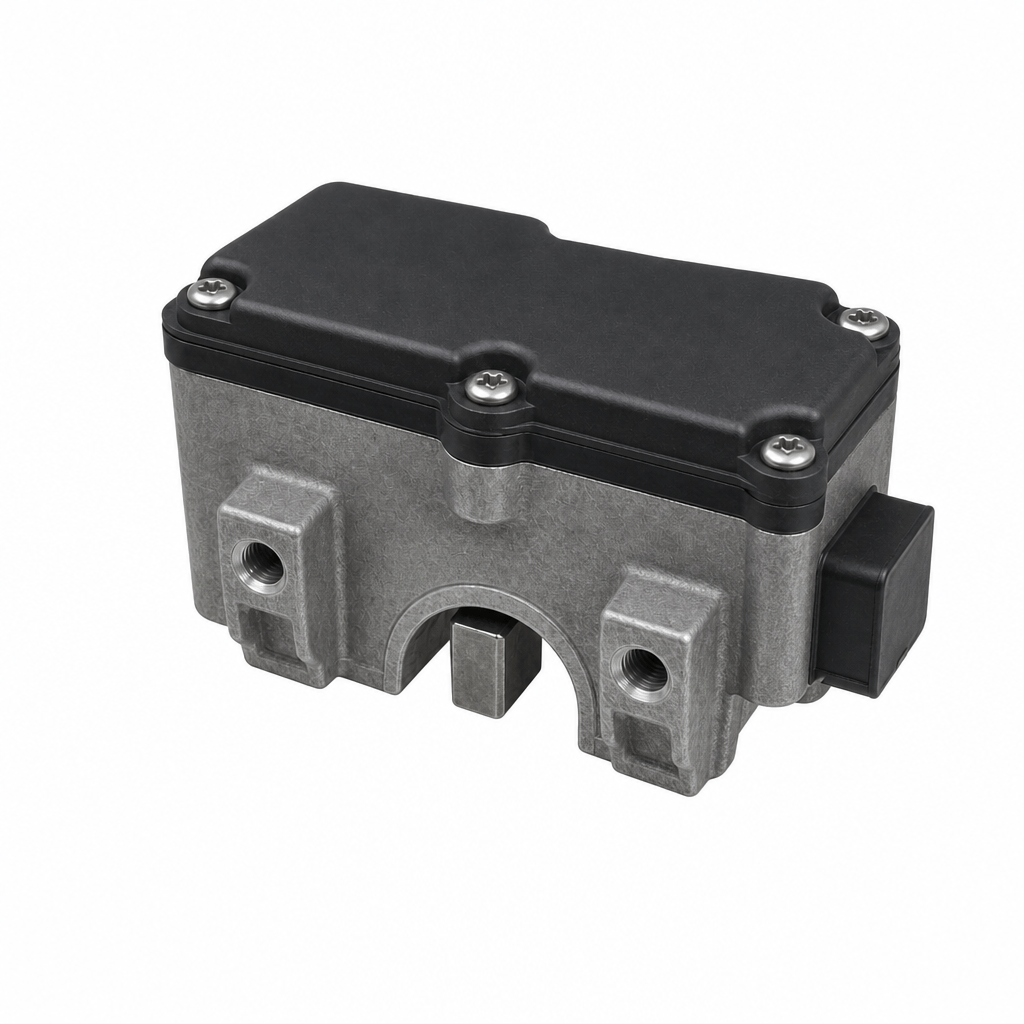
On a vehicle with a traditional key, the steering lock is part of the ignition barrel — turn the key and a bolt withdraws from the steering column. On a keyless vehicle there is no barrel to turn, so that job moves to an electronic steering column lock: a motor-driven bolt in a housing mounted on the steering column, commanded electrically. The EDK-911 is Youlai's version of that actuator. When the vehicle is parked and secured, the bolt is driven into the column so the wheel cannot be turned; on an authenticated start it withdraws in under a second so the driver can move off.
Because it is a security part, the two figures that matter are how fast it acts and how hard the bolt is to turn once engaged. The EDK-911 locks or unlocks in ≤ 1 s, and its engaged bolt holds against 40 N·m of applied torque for 2,500 cycles without damage — its published strength-under-load figure, not just an actuation-speed spec.
Part of the keyless (PEPS) chain
An ESCL rarely acts on its own — it is the actuator at the end of a keyless (PEPS) start-and-security chain. A driver carries a PEPS smart-key (a two-way fob that answers the controller's low-frequency challenge); the EBX-964 PEPS controller authenticates that key, and only then commands the EDK-911 to release the column and enable the start sequence. (On a 12 V platform the same controller role is filled by an integrated PEPS-BCM such as the EBX-2169, matched to a compatible 12 V lock rather than this 24 V part.) On shutdown the controller re-locks the column. The EDK-911 is the mechanical security endpoint of that decision; the authentication, immobiliser handshake and start-enable logic sit in the controller. For how the whole passive-entry / push-to-start loop works, see the PEPS keyless entry buyer guide.
One safety rule is fundamental to any steering lock: the column must never lock while the vehicle is moving. In a keyless system that interlock is typically handled in the controller logic rather than by the lock itself — the ESCL acts on the lock or unlock command it is given — which is one reason the ESCL and the keyless controller are specified and validated together as a set.
Strength & endurance
The EDK-911 carries two durability numbers because it does two different jobs. As a security bolt, it is qualified to hold against 40 N·m of applied torque for 2,500 cycles without damage — the kind of force that can be applied through the wheel against the engaged bolt. As an everyday actuator, the switching mechanism is rated to more than 50,000 operations, covering years of daily lock/unlock events with the sub-second action intact. The two figures together describe a part that has to be both hard to force and reliable over the life of the vehicle.
Environment
The lock mounts on the steering column inside the cab. Its −30 to +85 °C working range, with −40 to +90 °C storage, covers vehicles that cold-soak overnight and then heat up in the sun. It is specified for 24 V systems (18 – 32 VDC), which suits commercial and new-energy platforms; a 12 V passenger programme is evaluated separately rather than assumed to run on this 24 V part. Column interface, connector and the protection rating are set on the mounting drawing at quotation.
Manufacturing & testing
Built under IATF 16949 with APQP project planning, and a PPAP package is available on programme handover. Functional, endurance and bolt-strength validation against the ≤ 1 s, 40 N·m / 2,500-cycle and 50,000-operation figures is agreed in the control plan for each programme; where a design needs fresh validation, environmental screening runs in our in-house lab, with formal EMC certification handled at accredited third-party laboratories when the programme calls for it.
What we set with you at RFQ
The catalogue figures above — the timing, the bolt-strength and endurance numbers, the temperature range — are fixed. What still gets confirmed with you at quotation is how the lock lands on your vehicle and your keyless architecture:
- system voltage — and, for a 12 V passenger programme, whether a suitable variant can be offered;
- the keyless controller it must pair with, and the control interface and pinout to it;
- steering-column interface — clamp dimensions and orientation on the mounting drawing;
- the immobiliser / start-enable signalling and standstill interlock your programme uses;
- the protection rating and any programme-specific sealing for the mounting position;
- connector choice on the vehicle side, and expected annual volume.
Sending these up front means the first sample is matched to your column and controller, not a generic reference build.
Common questions
Is it a 12 V or 24 V part? It is specified for 24 V systems (18 – 32 VDC). For a 12 V passenger programme, ask us to evaluate a suitable variant — don't assume this 24 V part runs at 12 V.
How does it connect to the keyless controller? It is an actuator, not a standalone lock. On our EBX-964 PEPS controller the link is a wake / power / LIN interface to the lock motor; the exact interface and pinout are confirmed against your controller.
What stops the column locking while the vehicle is moving? Typically the controller, not the lock. The ESCL acts on the command it is given; the standstill interlock normally lives in the keyless controller logic, which is why the two are validated together.
What do the 40 N·m and 50,000-operation figures mean? The first is resistance to forced turning of the wheel with the bolt engaged (2,500 cycles without damage). The second is everyday actuation endurance — years of daily lock/unlock events.
Does it have an IP rating? It is a cabin-mounted part; the protection rating and any sealing are confirmed per programme rather than published as a fixed catalogue value.
How to ask
The EDK-911 belongs to the Switches & Sensors family and is normally quoted alongside the keyless controller it works with. To specify it, we need the steering-column interface (clamp dimensions and orientation), the keyless controller it must pair with, the system voltage (12 V or 24 V), and the immobiliser / start-enable signalling your programme uses. Please use the contact page with your target vehicle, controller pairing and expected annual volume. Drawings welcome.