
Most sealing arguments between an OEM and a supplier start with a line that looked complete at the time. The drawing said IP67. The part was quoted, tooled and fitted. Then the vehicles came back from a depot that cleans with a lance at close range, and the discussion turned into whose reading of that line had been wrong.
Nobody lied. IP67 is a genuine test result, and the part almost certainly passed it. The problem is that four characters are being asked to carry four separate answers: which standard the number was measured against, what state the sample was in, how the vehicle gets cleaned, and when the result was last re-checked. This guide takes them one at a time. Groove design, vent membranes, connector families and validation practice are covered on our IP65 / IP67 protection page; this one is about deciding the number and checking it.
- The second digit is not a ladder. IP66 is a jets test; IP67 is an immersion test — ask for both tests if the position sees both. What the digits mean
- Write the standard next to the number. IEC 60529 and ISO 20653 produce strings a procurement system cannot tell apart; IP5K2 is not a typo for IP52. IEC vs ISO 20653
- Choose by mounting position, not by vehicle type. The spread of exposure inside one vehicle is wider than the spread between types. By mounting position
- The rating describes the assembly as tested. An IP67 enclosure with an unsealed connector is a rated housing inside an unrated assembly. Where the rating stops
- The number never covers lance washing, chemistry or seal ageing. Those need their own lines; an immersion result does not speak for them. What it never covers
What the two digits promise
IP stands for Ingress Protection, and the general-purpose classification comes from IEC 60529, adopted in China as GB/T 4208. The first digit describes protection against solid objects, which for vehicle electronics mostly means dust. The second describes protection against water. Two characters are worth separating carefully, because procurement systems treat them alike: a 0 means the part is not protected against that characteristic, while an X means that characteristic was simply not declared. Neither is a failure, and they are not the same statement.
The single most expensive misreading in sourcing is treating the second digit as a ladder. It isn't one. IP66 is tested with powerful water jets; IP67 is tested by immersion for thirty minutes, with the lowest point of an enclosure under 850 mm tall sitting a metre below the surface. Those are different failure modes: jets attack a seal by pressure at a point, immersion attacks it by a sustained pressure differential over the whole surface. A part can pass one and fail the other, which is exactly why EBX‑2407 is published against both an immersion result and a jets result rather than the higher-looking number alone. If a position sees jets and standing water, ask for both digits to be demonstrated.
| Code | Solids | Water | Example |
|---|---|---|---|
| IP20 | Objects above 12.5 mm | Not protected | Cab-mounted onlyEBX‑2510 |
| IP4X | Objects above 1 mm | Not declared (vented) | Ventilated relay / fuse packNBX‑972 |
| IP53 | Dust-protected | Spraying water | In-cab modulesEBX‑2163 |
| IP54 | Dust-protected | Splashing water | Behind-dash distributionNBX‑957 |
| IP65 | Dust-tight | Jets, 6.3 mm nozzle | Sheltered VCU bracketEBX‑960 |
| IP66 | Dust-tight | Powerful jets, 12.5 mm nozzle | Chassis side, spray pathEBX‑2052 |
| IP67 | Dust-tight | Temporary immersion, 30 min | Low chassis / fordingNBX‑971 |
| IP68 | Dust-tight | Continuous immersion; depth / duration agreed (harder than IPX7) | Fan-cooled traction housingsEBX‑2512 |
Read that first-digit column downwards and a pattern shows up in our own range. Once a part leaves the cab, the solids digit settles at 5 or 6 and stops moving, while the water digit spans the whole table. Dust protection tends to arrive as a by-product of any competently gasketed housing; water performance is the thing you actually specify, and the thing you pay for.
IP68 deserves a note here, because it reads as the top of a scale without behaving like one. Unlike the levels below it, IP68 carries no fixed test condition. The standard requires only that the agreed condition be more severe than the IPX7 immersion, and leaves the depth and duration to the parties — which is why the EBX‑2512 and EBX‑2514 entries state that the profile is signed off per programme. An IP68 line with no agreed depth behind it carries less information than an IP67 line, not more.
The automotive code is not the IEC code
This is the part that catches experienced buyers, because both code systems produce strings a procurement system cannot tell apart. Road-vehicle components are commonly classified under ISO 20653, which defines ingress tests for road-vehicle conditions that IEC 60529 never covered; China's GB/T 30038 is a modified adoption of it. ISO 20653 marks those degrees with a K — and, for solids, it writes dust-protected and dust-tight as 5K and 6K rather than 5 and 6.
So IP5K2 is not a typo for IP52, and the two are not interchangeable on a drawing. Our own dashboard range shows the two conventions sitting side by side: the TDK‑901 hazard switch is published at IP52, the TDK‑2513 illuminated button at IP5K2. Two cab switches, two standards, one careless transcription away from being treated as the same requirement. Others are published in the automotive code because that is what they were tested to: JDK‑2306 and the TDK‑2406 / TDK‑2407 stop-request buttons at IP5K2, and EDK‑2006 at IP5KX — where the X is doing real work, because that part was assessed for dust and carries no water rating at all.
Where a comparison is unavoidable, the honest form is a nearest reference rather than a conversion. Our EBX‑2054 telematics unit is published as IP5K0 to GB/T 30038 / ISO 20653, with the note that the closest IEC 60529 reference is IP5X and that no liquid test was performed. That phrasing is deliberate. Restating an automotive result as an IEC code, or the reverse, quietly claims a test that nobody ran.
The same care applies to shorthand that blends the two systems, including our own. EBX‑2407 is published as IP67 plus IP66K: an immersion result in the IEC form, and a jets-at-increased-pressure result in the automotive form. Written strictly to ISO 20653 that second result would read IP6K6K, since the solids element is K-marked there too. The testing is not in question; the shorthand is simply what the industry prints. But if the jets result is the one carrying your position, ask for the full code and the standard behind it, and write it into the drawing in that form — from us as readily as from anyone else.
The consequence for an RFQ is small to write and expensive to skip: state the standard as well as the number. Two suppliers can return identical digits against different tests, and the string alone will not tell you which of them ran the harder one. Our bus and coach page carries the same requirement for saloon and cab parts, where mixed-code datasheets are routine.
Choose by mounting position, not by vehicle type
Requirements often arrive sorted by vehicle. Construction machinery, therefore IP67 across the build; city bus, therefore IP65. It is an understandable shortcut and it is the wrong axis, because the spread of exposure within one vehicle is wider than the spread between vehicle types. An excavator's sealed cab and its undercarriage belong to the same machine and share almost nothing in ingress terms. A roof-mounted box on a city bus and a wheel-arch bracket on that same bus are further apart from each other than either is from its counterpart on a mining truck.
Two parts from the same dashboard make the point better than an argument does. TDK‑2513 and TDK‑2514 are catalogued together as cab switches, and they carry different ratings: IP5K2 for the panel-mounted illuminated button, IP57 for the threaded-body pre-ignition switch, which the datasheet pairs with a more exposed threaded-through mounting. Same cab, same harness, different sealing levels — and, as the previous section warned, two different code conventions inside one line item. Sorting by vehicle would have handed both the same number and got one of them wrong in either direction.
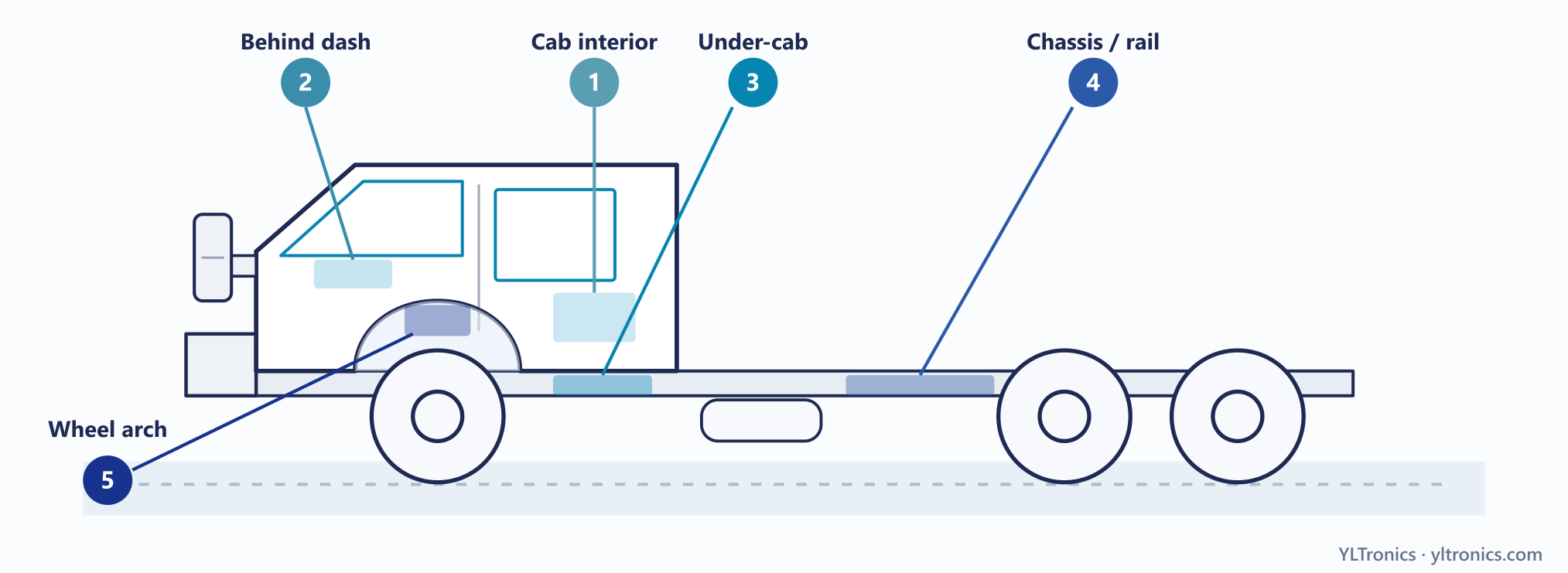
Five zones on one vehicle — dust and water are separate tests, not one rising scale
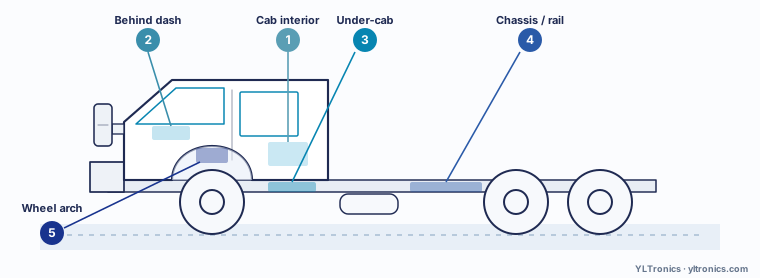
| Position | Dust | Water | Examples |
|---|---|---|---|
| Cab interior Panel / console | Protected | Spills and wipe-down | EBX‑2510 · or IP5KX / IP5K2 (automotive) |
| Behind the dash Under cover / trim | Protected | Condensation, minor leaks | NBX‑2301, EBX‑954 |
| Sheltered under-cab Floor pan / body void | Tight (pref.) | Splash and run-off | EBX‑960B · or IP5K2 (EBX‑2406) |
| Chassis, exposed Frame rail, engine bay, roof | Tight | Road spray / rain — jets, not immersion | NBX‑968, EDK‑2507, YDK‑902 |
| Wheel arch / low chassis Below frame; spray / fording | Tight | Temporary immersion | NBX‑971, NBX‑961, JDK‑2201 |
Over-specification has a price that rarely appears in the sealing discussion. Moving a cab part to IP67 usually brings sealed connectors on both ends of the harness, a larger housing to carry the gasket compression, a vent component to handle the pressure differential the new seal creates, and a part that is harder to open for service. A dashboard switch specified for immersion is not safer for being sealed; it is heavier, more expensive to tool, and slower to repair in a depot. Scoping by position rather than by vehicle puts the money where the water actually is.
The reverse move is easier than most teams expect. EBX‑2404 is published at IP5K2 for behind-dash use, with an optional sealing gasket on the connector face taking it to IP65 for a wet-zone position — a variant to be specified and qualified at quotation, not a field modification. That is the normal shape of a well-run sealing decision: one platform, a defined upgrade path, and a level chosen per position rather than per catalogue line. NBX‑957 works the same way, with an IP65 variant available against an IP54 baseline.
The rating belongs to the assembly, not the box
An IP result is a statement about a specific sample in a specific state. That sounds like pedantry until you notice how much of a finished installation sits outside the enclosure the test report describes: mating connectors, harness entries, cover plates, vent components, and the mounting face itself.
The clearest illustration in our range is the entry that refuses to give a number. NBX‑966 is published as open style, with the IP rating set by the harness boots and the surrounding enclosure rather than by the part. Nothing is being withheld there. For an open-style distribution block, the sealing boundary genuinely lives in the installation, and a number printed on the datasheet would be a claim about somebody else's design. The same logic runs quietly through the rest of the catalogue: NBX‑2404 at IP54 assumes a cabin or under-dash placement, and EBX‑2209 at IP53 notes that a sealed-connector variant should be specified at quotation if the module is going under the chassis instead.
Fit an IP67 enclosure with an unsealed connector and the box's test result stops describing what you have installed. You have a rated housing inside an unrated assembly, and water takes the cheapest path in rather than the average one. Which connector family, gland or bulkhead seal closes that boundary is a hardware question covered on the protection page, and how to choose and specify that connector — sealed against unsealed, which half you are ordering, and what a sealed set actually contains — is worked through in the automotive connector guide. The sourcing question here is simply whether the test sample had those parts fitted, and it belongs in the RFQ rather than in the post-mortem.
When sealing is not the goal
There is a failure mode that a higher IP number makes worse rather than better, and it is heat. Seal an enclosure completely and the losses inside it have nowhere to go except through the housing wall.
NBX‑972 carries the undeclared water character from the table above, and that is the design intent rather than an omission: the enclosure vents so a high-density relay and fuse pack can cool by convection. For a densely packed pack in a protected position, that airflow is worth more than an ingress digit. Specifying IP67 for the same function would buy either a much larger housing or a thermal problem, and probably both.
The same tension shows up at the top of the range, which is why the IP68 entries read the way they do. EBX‑2512 and EBX‑2514 declare IP68 for the sealed aluminium-alloy main housing, and both still need cooling-fan air paths. Those paths are sealed to the programme specification, the immersion depth and duration are signed off per programme, and the installation guidance is to keep the air paths clear and out of sustained direct jets. Read precisely, that is a rating scoped to a housing plus a mounting condition.
What the number never covers
Each test in the classification is a defined, bounded exposure — clean water or laboratory dust, on a part that has not yet been in service. Treating that snapshot as a durability rating is where most field failures begin, and what sits outside it is not marginal.
High-pressure and high-temperature washing. IP67 covers standing water at rest. Depot cleaning with a lance is a different event with its own test, and the naming is worth getting right on a drawing: IPX9K in ISO 20653, IPX9 in IEC 60529, and the market shorthand IP69K inherited from DIN 40050-9. Whichever form you write, the condition is roughly 80 °C water at 80 to 100 bar from a defined nozzle and distance, and it has nothing to do with the immersion result. Our published range carries no part released against that test, so a programme that cleans this way has to define the duty at project start and test it in its own right.
Chemistry. Diesel, hydraulic oil, urea solution, brake cleaner and road-salt brine attack elastomers on timescales the ingress test never sees. A gasket compound that holds water out perfectly can swell, harden or take a permanent set after repeated contact with the wrong fluid, and the part will then fail an ingress test it originally passed. Salt-spray exposure to ASTM B117 addresses the corrosion side of this at terminals and housings, which is a different question from ingress and needs its own line in the specification.
Ageing and thermal cycling. Seals are compressed rubber, and compressed rubber relaxes. Over the −40 to +85 °C window most of our range works to, an enclosure breathes on every cycle: warm air expands, cooling air contracts, and the pressure differential works at the seal and pulls moisture towards any weak point. What drives the count is the duty pattern rather than the annual hours. A refuse truck that heat-soaks and cools through dozens of stop-start cycles a shift accumulates them far faster than a line-haul tractor covering the same distance in one run. The hardware answer is a pressure-equalisation component rather than a tighter seal; the sourcing point is that when the ingress test was run relative to environmental conditioning changes what the result means.
Vibration at the seal face. Chassis-mounted electronics are shaken continuously, and a housing whose mounting feet flex will eventually move its own split line. This is why the mounting arrangement, not just the enclosure, belongs in the conversation. Environmental and mechanical validation practice is described under EMC and environmental testing.
How to check an IP claim before you rely on it
A rating is quick to print and slower to evidence, and what sits behind it decides whether you are building on it or quietly inheriting risk. The requests below take a supplier minutes to answer, and they are best made at RFQ stage, while they still cost nothing, rather than at PPAP, when the tooling is already cut.
- The standard and the edition, not just the digits. IEC 60529 or ISO 20653 / GB/T 30038, stated explicitly. If nobody can say which, the number has not yet been traced back to a report.
- The state of the tested sample. Were the mating connectors fitted, the harness boots installed, the cover plates in place and the vent component present? This single question resolves most of the boundary problem described above, because it forces the report to describe the assembly rather than the housing.
- The pass criterion that was applied. IEC 60529 does not define what counts as failure for every product; the product specification does. Ingress of a quantity of water that harms nothing is a pass in some programmes and a reject in others, so agree which reading applies to you.
- Whether the sample was production-representative, and when it was tested. A hand-built sample sealed with care is not the same evidence as a tooled part off the production process, and a test run before environmental conditioning tells you less than one run after it. On our side, ingress results can be included in the PPAP package where a programme calls for one, which is the natural place for this to be documented.
None of this is adversarial. A supplier who has run the test answers all of it in a paragraph; one who cannot has told you something useful at the stage where it is still cheap to act on. The wider set of supplier-side evidence — IATF 16949, APQP, PPAP and how to verify each — is set out in our sourcing guide.
Writing the requirement into a specification
Everything above collapses into one line on a drawing or one row in an RFQ. Here is the version that starts arguments, and the version that ends them.
Enclosure protection: IP67
Still open Rating & standard Mounting zone Sample state Cleaning duty Re-check
Four characters look finished on a drawing. The row still needs these five cells filled.
IP67 to IEC 60529 — dust-tight; immersion 30 min at the 1 m reference depth
Chassis rail, below frame level, in the wheel-spray path
As-shipped: mating connectors fitted, harness boots installed, vent component fitted
Depot lance cleaning — qualify separately to ISO 20653 IPX9K, or to a project lance test stating nozzle, distance, temperature and pressure. Not inferred from the immersion result
Ingress verification after thermal cycling −40 to +85 °C per programme profile
The same five cells, completed. Each one closes an assumption somebody would otherwise make on your behalf.
That block is the ingress row only. The commercial and programme context around it — volumes, connector preferences, timing, qualification expectations — belongs in a complete request, and our RFQ checklist covers the other rows. If you are still deciding where each box sits before worrying about how it is sealed, the E/E architecture guide is the layer above this one.
If you are scoping a platform now, the practical next step is usually a short call over the zone list rather than a datasheet exchange: name the positions, name the cleaning routine, and the levels tend to fall out on their own.